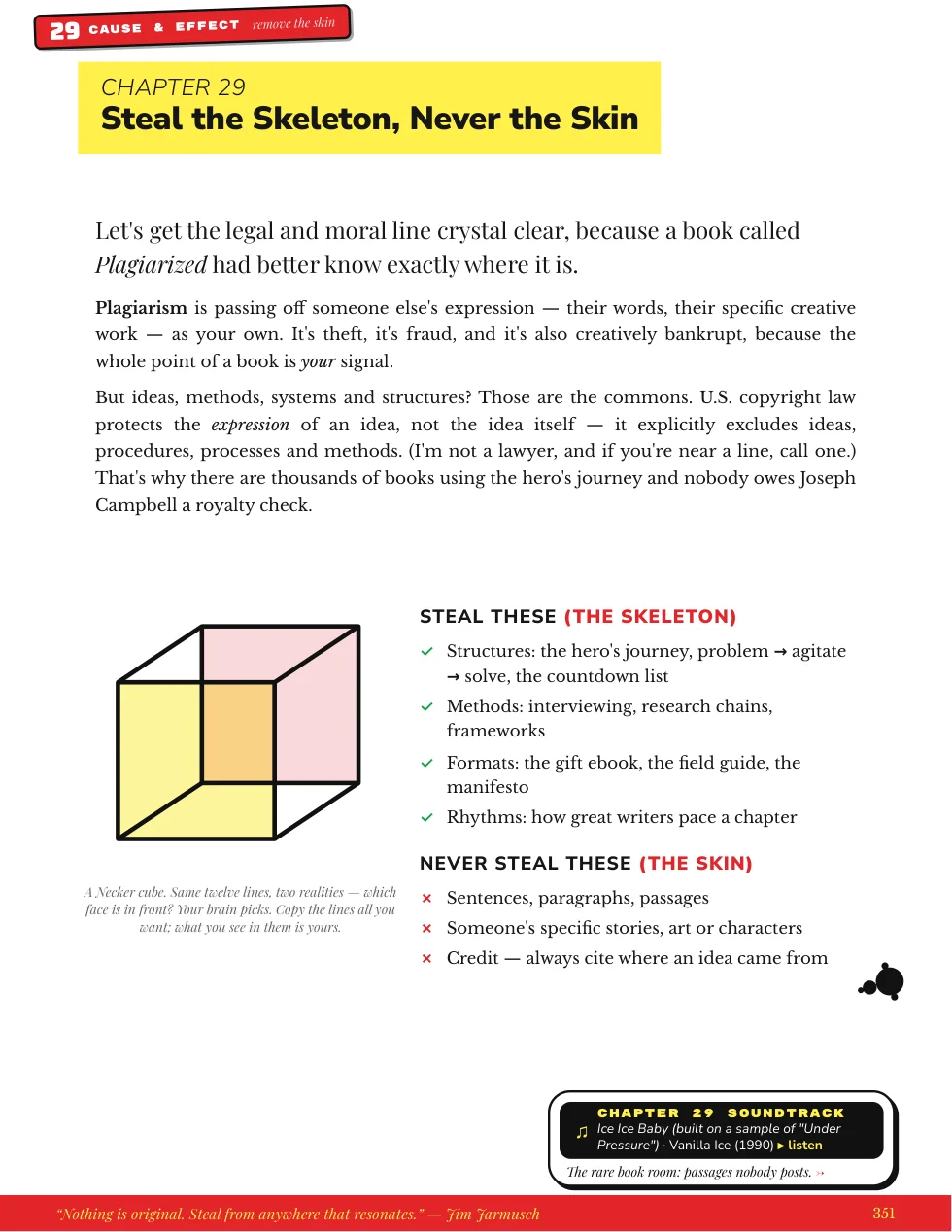
CHAPTER 29 Steal the Skeleton, Never the Skin Let's get the legal and moral line crystal clear, because a book called Plagiarized had better know exactly where it is. Plagiarism is passing off someone else's expression — their words, their specific creative work — as your own. It's theft, it's fraud, and it's also creatively bankrupt, because the whole point of a book is your signal. But ideas, methods, systems and structures? Those are the commons. U.S. copyright law protects the expression of an idea, not the idea itself — it explicitly excludes ideas, procedures, processes and methods. (I'm not a lawyer, and if you're near a line, call one.) That's why there are thousands of books using the hero's journey and nobody owes Joseph Campbell a royalty check. A Necker cube. Same twelve lines, two realities — which face is in front? Your brain picks. Copy the lines all you want; what you see in them is yours. STEAL THESE (THE SKELETON) NEVER STEAL THESE (THE SKIN) Structures: the hero's journey, problem → agitate → solve, the countdown list ✓ Methods: interviewing, research chains, frameworks ✓ Formats: the gift ebook, the field guide, the manifesto ✓ Rhythms: how great writers pace a chapter ✓ Sentences, paragraphs, passages ✗ Someone's specific stories, art or characters ✗ Credit — always cite where an idea came from ✗ “Nothing is original. Steal from anywhere that resonates.” — Jim Jarmusch 351
The podcast · Launching 2027
Get the first episode in 2027. Better late than never.
By signing up you agree we can email you when the podcast launches. One email, maybe two. Unsubscribe anytime.
Visit the podcast →The podcast · Launching 2027
Get the first episode in 2027. Better late than never.
By signing up you agree we can email you when the podcast launches. One email, maybe two. Unsubscribe anytime.
Visit the podcast →