exhibit · debated
THE LINE TO TAKE WITH YOU
You didn't get a ghostwriter. You got a mirror of the mean.
Leave the default. Keep yourself.
Aaron Bare · Director’s Cut · author’s argument
Wing I · Room 1
Unlearn DEFAULT — taking the average answer as the answer. Upgrade: Calm Discernment
Today you asked something a question, took the first answer and moved on.
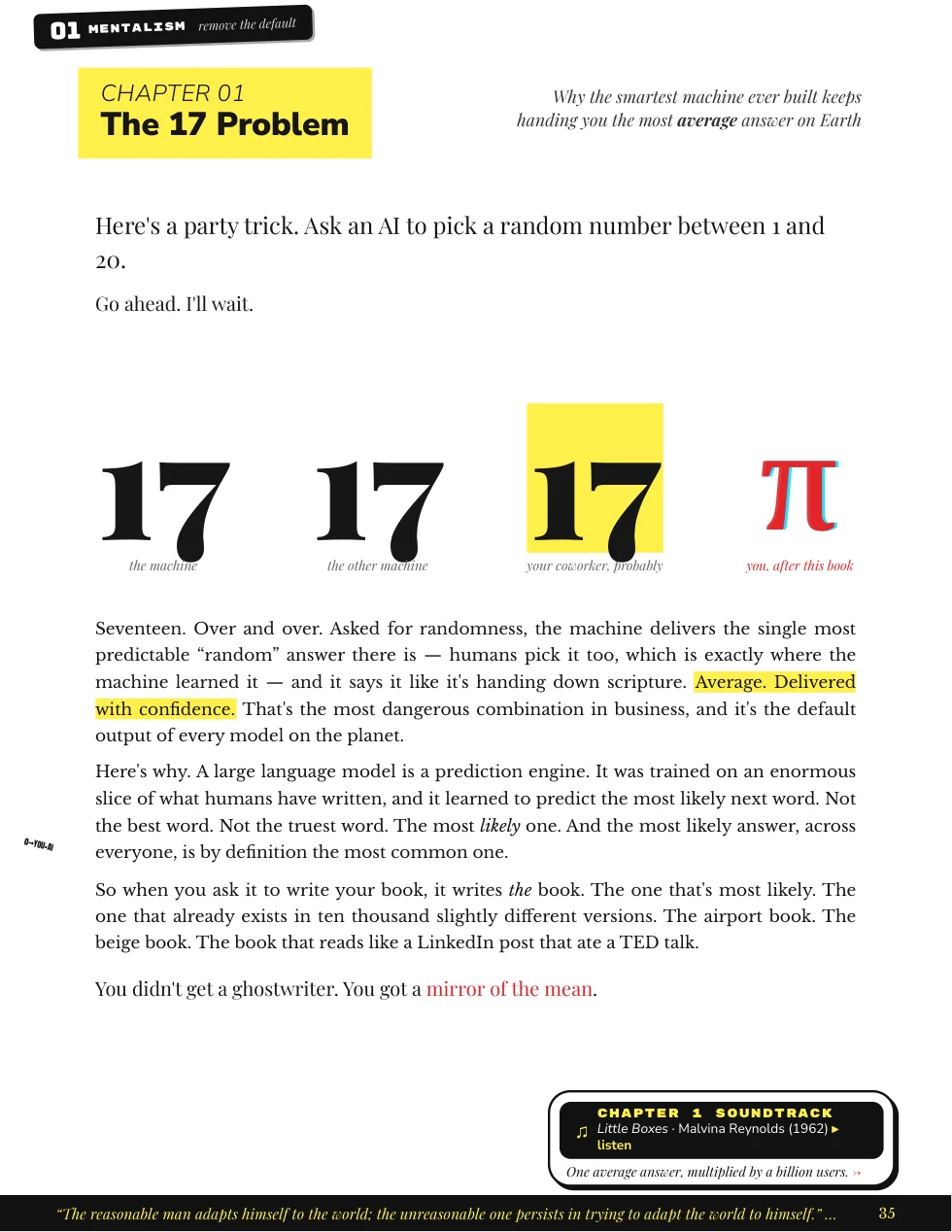
Try this at the next party. Open any chatbot and type: pick a random number between 1 and 20.
It says 17.
Not every time. Not every model. But often enough that it stopped being a coincidence and started being a mirror. Ask a room full of humans the same question and a suspicious number of them say 17 too. Seven feels random. Odd feels random. Teen-something feels random. Put those feelings together and you get the most average "random" number on Earth.
The machine didn't invent that. It learned it from us.
YOU DIDN'T GET A GHOSTWRITER. YOU GOT A MIRROR OF THE MEAN.
Here's the part nobody puts on the box. A large language model doesn't look for the best answer. It doesn't look for the truest answer. It predicts the most likely next word, then the next one, then the next one, based on everything people have already written. Most likely. Not most interesting. Not most yours.
That's a superpower when you need the boring stuff done. Spelling. Summaries. The email that says "attached is the thing." It's a trap when you need anything that has to sound like a human being with a pulse wrote it.
✎ likely ≠ true ≠ yours
In 2024, two researchers, Anil Doshi and Oliver Hauser, ran an experiment on short stories. Some writers got AI ideas to work with. Some didn't. Readers rated the AI-helped stories as better, especially for writers who weren't confident to begin with. VERIFIED
Then they compared the stories to each other. The AI-helped stories were more alike.
Read that twice. Each person got a little better. Everyone got a little more the same. Individually, an upgrade. Collectively, beige.
Now zoom out. Picture millions of people asking the same machine for the same kind of thing, every day. Then picture that output getting posted, scraped and fed back into the next machine. Some researchers have modeled this as a "death spiral of homogenization," where the average keeps averaging itself. It's a model, not a measurement. Nobody has filmed the spiral yet. DEBATED
If you run a company, you've heard the pitch. Add AI, get magic. An MIT report in 2025 claimed roughly 95% of enterprise generative-AI pilots showed no measurable profit-and-loss impact. People argued about how they counted, and they should. DEBATED But the shape of it rings true for anyone who has watched a company buy a tool and keep the same habits. Same thinking, faster. Same results, cheaper. Same results.
AVERAGE × AI = MORE AVERAGE, FASTER.
No. That's the wrong herd to join. "AI is bad" is also an average answer.
The problem isn't the machine. The problem is the default. The default is: ask, accept, move on. The default treats the first answer like a verdict instead of a draft. And the default is exactly what the machine is best at predicting, because it's what most people do.
The 17 isn't a bug in the AI. It's a bug in the habit.
You don't need a new app. You need a new reflex. Before you take any answer, from a machine, a boss, a feed, a parent living in your head, ask one question:
What's the average answer, and what's mine?
The average answer is useful. It tells you where the crowd is standing. Your answer is where the value lives, because it's the one nobody else can produce. The machine can give you ten thousand 17s. It cannot give you you.
That's the whole installation, honestly. Subtract the defaults. Bring the you. Then multiply.
✎ zero → you × AI
Take the Temperature Dial below. Paste it into whatever AI you use. It forces three answers: the likely one, the original one, and the one nobody in your field would say out loud. Then pick. Picking is the human part.
--→ the death spiral of sameness This isn't just a vibe. Researchers have started measuring it. A 2024 study in Science Advances by Anil Doshi and Oliver Hauser found that writers who got AI story ideas produced stories rated more creative and better written — but the AI-assisted stories became more similar to each other.
Better for each person. Worse for everyone. That's the sameness machine in one sentence.
Now scale it. Every marketing team asking the same model for positioning. Every founder asking for the same go-to-market plan.
Every “thought leader” asking for the same framework. Then: 1. All of that output gets published back onto the internet.
The next generation of models trains on more of the middle. 4. Which hands everyone an even more middle answer.
It's a theoretical model, not a field measurement. But you don't need a model. Open your inbox.
MIT's 2025 NANDA report found roughly 95% of enterprise generative AI pilots showed no measurable impact on the P&L. Critics argue with the sample, fine. But the direction is obvious: companies are spending a fortune to get average faster.
And here's the trick nobody warns you about: these tools are analogy engines, not first- principles thinkers. They produce what resembles a good answer. Ask about your close rate, you get persuasion tips.
Ask about scaling, you get “turn up the volume.” Worse, most of what they learned about business was written before AI existed — so they hand you a playbook for a world that's already gone, and it sounds right because you're experienced. Your competence becomes the trap. The fix isn't to stop using AI.
The fix is to stop using it cold. AI predicts the most likely answer. Most likely for whom?
If it doesn't know you, the answer is “for everyone.” “There is no spoon.” — The Matrix (1999) 36 AARON NOTE: I wrote Exponential Theory. This book is the bug report. A dead man saw this coming in 1897. →
AND YOU THINK YOU'RE ORIGINAL? Your accent, your jokes, your politics, your favorite song — downloaded. Good.
Now remix it so hard nobody can find the source. That's the only original there is. Shuffle a deck and prove it. →
A A 7 7 Q Q 3 3 K K 9 9 J J 52! = 52 × 51 × 50 × … × 1 ≈ 8 × 1067 possible orders. If every person on Earth shuffled a deck every second since the Big Bang, they’d still have covered a vanishingly tiny fraction of them. A well- shuffled deck is almost certainly a first.
VERIFIED YOU CAN’T AVOID BEING ORIGINAL. YOU CAN ONLY AVOID SHOWING IT. Your genes, your scars, your playlist, your weird lunch order and that one teacher: same 52 cards everyone gets, in an order nobody has ever held.
Plagiarize everything. You’ll still end up as a first edition. 26 letters wrote every book ever 12 notes made every song 4 DNA bases built every living thing 52 cards.
New order every shuffle. 39 AND YOU THINK YOU’RE ORIGINAL? SHUFFLE A DECK OF CARDS.
You just made something that has almost certainly never existed before.
1 If you’re in a race and you pass the person in second place, what place are you in? 2 How many animals of each kind did Moses take on the ark? 3 A farmer has 17 sheep.
All but 9 run away. How many are left? 4 Mary’s father has five daughters: Nana, Nene, Nini, Nono.
What’s the fifth one’s name? 5 A father and son are in a car crash. The surgeon says, “I can’t operate, he’s my son.” How?
6 What’s heavier: a pound of feathers or a pound of bricks? Second. Most people say first.
None. It was Noah. The “Moses illusion” (Erickson & Mattson, 1981): your brain reads what it expects.
If it took a second, that second is the bias. Same. A pound is a pound.
Your gut hates that. BRAIN TEASERS 40 BRAIN TEASERS · SEASON I · ANSWERS UPSIDE DOWN SIX QUESTIONS YOUR BRAIN WILL GET WRONG. Answer fast first.
Then answer slow. The gap between the two is the whole lesson of this book. baaa.
Soundtrack: Little Boxes — Malvina Reynolds (1962)
You didn't get a ghostwriter. You got a mirror of the mean.
Leave the default. Keep yourself.
Aaron Bare · Director’s Cut · author’s argument
AND YOU THINK YOU'RE ORIGINAL? Your accent, your jokes, your politics, your favorite song — downloaded. Good. Now remix it so hard nobody can find the source. That's the only original there is. Shuffle a deck and prove it. →
Answer fast first. Then answer slow.
TODO: HUMAN INPUT REQUIRED — supply the six Room 01 questions.
You've met the machine's favorite number. Next: what happens when everyone uses it at once.
The podcast · Launching 2027
By signing up you agree we can email you when the podcast launches. One email, maybe two. Unsubscribe anytime.
Visit the podcast →