Beauty is average. That's not an insult. It's a finding.
In 1990, psychologists Judith Langlois and Lori Roggman blended photographs of faces together and asked people to rate them. The composites — the averages — were rated more attractive than almost every individual face that went into them. The paper's title said it plainly: "Attractive Faces Are Only Average." VERIFIED
The composite face of prose
Now look at AI writing. It's the composite face of prose. Smooth. Symmetrical. Pleasant. No scars, no crooked teeth, nothing you'd remember on the drive home. AI writing is beautiful in exactly the way an averaged face is beautiful — and just as forgettable.
BLENDING IN WAS NEVER THE GOAL.
Francis Bacon, four centuries early: "There is no excellent beauty that hath not some strangeness in the proportion."
Why it won't write the next Catcher
It won't write Hemingway either. It will write the average of everyone who ever tried to sound like Hemingway.
Think about what made those books. Salinger handed the whole novel to one teenage voice so specific, so rude, so wounded and so funny that readers have argued with Holden Caulfield for more than seventy years. Hemingway built a style out of what he left out — the iceberg idea: the power of a story lives in the seven-eighths underwater. One man wrote the most improbable voice of his generation. The other wrote by deleting the probable.
A prediction engine does the exact opposite of both. It adds the probable and deletes the improbable. It can describe Holden. It can imitate a Hemingway sentence. What it cannot do is be the first person to need to write that way — because the need came from a life the machine never lived.
That's the real divide of the next decade. Not people who use AI versus people who don't — everyone will use it, the way everyone uses electricity. The divide is between people who bring something the machine can multiply and people who bring nothing and get the middle back at the speed of light.
✎ ordinary is no longer a starting point. it's a default setting.
The summary is not the book
The Iliad. Meditations. Hamlet. Moby-Dick. Beloved. The summary gives you the plot, the themes, the quiz answers — thirty seconds, done, useful the way a map is useful. The reading gives you six hundred pages living inside someone else's head: patience, empathy, an argument you have to fight. The map isn't the territory. Use the machine to explore the book — argue with Dostoevsky, map the symbols, quiz yourself on Plato. Then read it anyway. Then write your own. The goal isn't to have read them. The goal is to write the 101st.
And the rep, from the mirror star: prop the page in front of a mirror, look only at the mirror, trace the star. It's awful at first. Patient H.M., who couldn't form new memories, got better at this for days without remembering practicing — Brenda Milner, 1962. VERIFIED Your hands learn even when your story says you can't. Your brain does the homework overnight.
ROOM 20
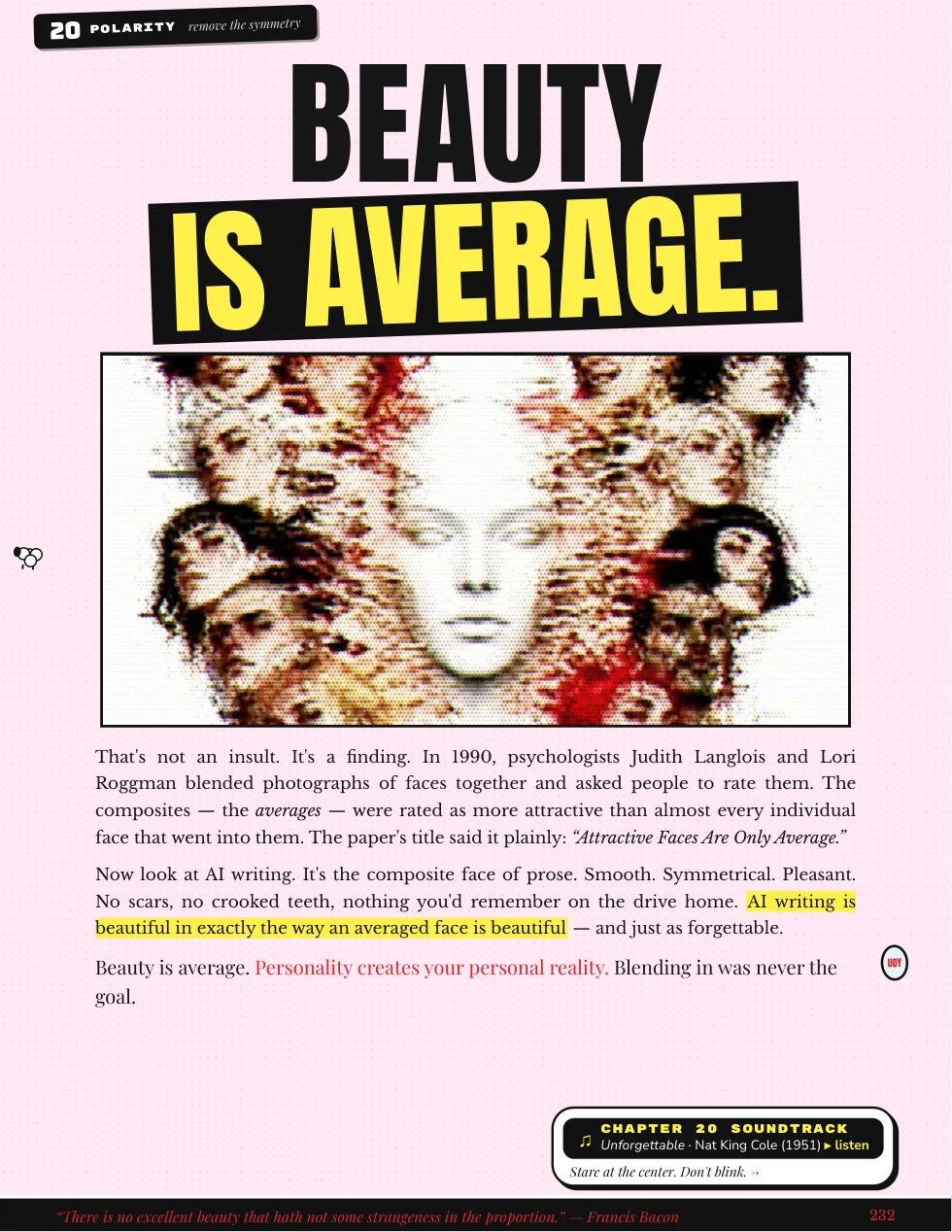
BEAUTY IS AVERAGE. That's not an insult. It's a finding.
In 1990, psychologists Judith Langlois and Lori Roggman blended photographs of faces together and asked people to rate them. The composites — the averages — were rated as more attractive than almost every individual face that went into them. The paper's title said it plainly: “Attractive Faces Are Only Average.” Now look at AI writing.
It's the composite face of prose. Smooth. Symmetrical.
Pleasant. No scars, no crooked teeth, nothing you'd remember on the drive home. AI writing is beautiful in exactly the way an averaged face is beautiful — and just as forgettable.
Beauty is average. Personality creates your personal reality. Blending in was never the goal.
“There is no excellent beauty that hath not some strangeness in the proportion.” — Francis Bacon 232 YOU
THE ORIGINAL · 234
AI WILL NOT WRITE THE CATCHER IN THE RYE. It won't write Hemingway either. It will write the average of everyone who ever tried to sound like Hemingway.
Think about what made those books. Salinger handed the whole novel to one teenage voice so specific, so rude, so wounded and so funny that readers have argued with Holden Caulfield for more than seventy years. Hemingway built a style out of what he left out — his “iceberg” idea, that the power of a story lives in the seven-eighths underwater.
One man wrote the most improbable voice of his generation. The other wrote by deleting the probable. A prediction engine does the exact opposite of both.
It adds the probable and deletes the improbable. It can describe Holden. It can imitate a Hemingway sentence.
What it cannot do is be the first person to need to write that way — because the need came from a life the machine never lived. That's the real divide of the next decade. Not people who use AI versus people who don't.
Everyone will use it — the way everyone uses electricity. The divide is between people who bring something the machine can multiply and people who bring nothing and get the middle back at the speed of light. Ordinary is no longer a starting point.
It's a default setting — and it ships pre- installed. Extraordinary is the only thing left worth doing by hand. AI WILL WIN WITH PEOPLE WHO THINK BIG AND EXPONENTIAL.
Everyone else? Fucking average. Ordinary.
Faster than ever. CALLBACK: the refrigerator CFO says hi. Your trophy depends on who stands next to you. →
THE ORIGINAL · 236
The Iliad Homer The Republic Plato Meditations Marcus Aurelius Hamlet Shakespeare Don Quixote Cervantes Pride and Prejudice Austen Frankenstein Mary Shelley Crime and Punishment Dostoevsky Moby-Dick Melville One Hundred Years of Solitude García Márquez Beloved Toni Morrison The Catcher in the Rye Salinger WHAT THE SUMMARY GIVES YOU The plot, the themes, the quiz answers. Thirty seconds, done. Useful the way a map is useful.
WHAT THE READING GIVES YOU Six hundred pages living inside someone else’s head. Patience, empathy, an argument you have to fight. The map isn’t the territory.
WHAT SURVIVES Use AI to explore the book: argue with Dostoevsky, map Moby-Dick’s symbols, quiz yourself on Plato. Then read it anyway. Then write your own.
“AI can remix every great book ever written. It can’t have lived the life that made one.” Ten lists of 100 books, free, at the 100 Great Books club. Read them with an AI at your side as a tutor, never a substitute.
The goal isn’t to have read them. The goal is to write the 101st. ▶ THE HUNDRED · ONEHUNDREDGREATBOOKS “Life is like a box of chocolates. You never know what you're gonna get.” — Forrest Gump (1994) 236 THE HUNDRED · FROM 100 GREAT BOOKS AI WILL NEVER WRITE THESE.
But it can be the best study partner you ever had. The summary is not the book. baaa.