← INAUTHENTIC · The map

Wing V · Room 23

The Seventh D

Unlearn SAFE BET — doing nothing because sameness pays

The seventh D is duplicate.

Page art for room 23

ROOM 23

THE SEVENTH D IS DUPLICATE. DIGITIZE DECEPTIVE DISRUPTIVE DEMONETIZE DEMATERIALIZE DEMOCRATIZE DUPLICATE Peter Diamandis and Steven Kotler's 6Ds of disruption were the backbone of my first book, and they're a genuinely useful map. But I only ever ran them forward.

Run them to the end and you hit the D nobody puts on the slide: duplicate. Once something is democratized, everyone has it. Once everyone has it, everyone uses it the same way.

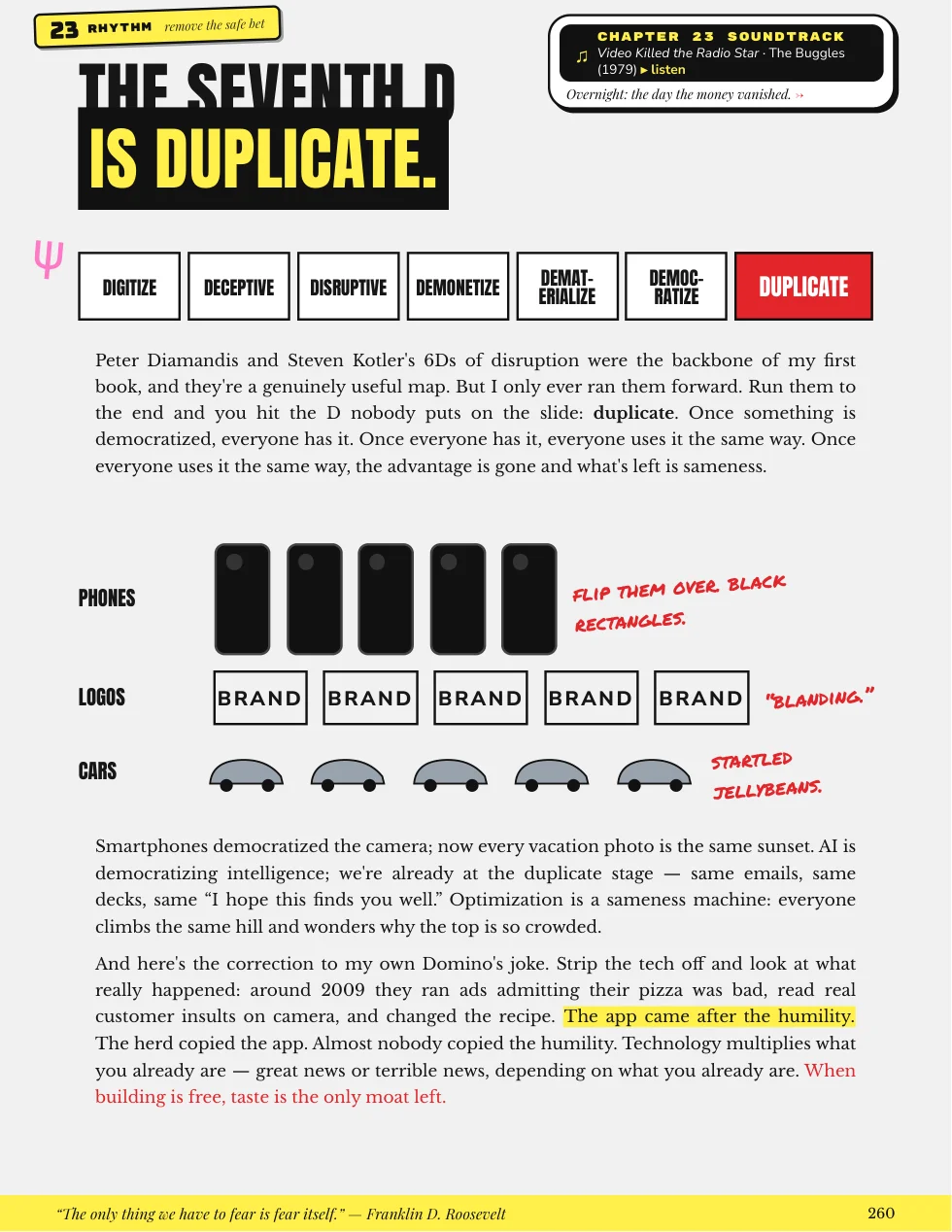
Once everyone uses it the same way, the advantage is gone and what's left is sameness. PHONES LOGOS BRAND BRAND CARS flip them over. black rectangles. “blanding.” startled jellybeans.

Smartphones democratized the camera; now every vacation photo is the same sunset. AI is democratizing intelligence; we're already at the duplicate stage — same emails, same decks, same “I hope this finds you well.” Optimization is a sameness machine: everyone climbs the same hill and wonders why the top is so crowded. And here's the correction to my own Domino's joke.

Strip the tech off and look at what really happened: around 2009 they ran ads admitting their pizza was bad, read real customer insults on camera, and changed the recipe. The app came after the humility. The herd copied the app.

Almost nobody copied the humility. Technology multiplies what you already are — great news or terrible news, depending on what you already are. When building is free, taste is the only moat left.

“The only thing we have to fear is fear itself.” — Franklin D. Roosevelt 260 ψ

THE ORIGINAL · 262

FROM a company WHY SAMENESS PAYS. Every system gets the results it rewards. So if the whole world is getting average, somebody's paying for average.

Here's sameness run through the Lab's six-dimension incentive scan. VISIBLE What gets measured: posts shipped, words written, tickets closed, “AI adoption.” Volume is easy to count. Originality isn't.

So volume wins. HIDDEN Career safety. Economists have modeled it for decades: a manager who fails with the crowd keeps his job; one who fails alone gets fired.

Nobody ever got fired for the consensus answer. PERVERSE AI made average free. Now the cheapest strategy is to flood the zone with it — and every system that pays for volume pays you to make the world dumber.

MISSING Nobody pays for taste, for judgment, for being publicly wrong on the way to being right. No KPI for “said something only we could say.” AI The machines are rewarded for being likely and likable. Most probable word.

Answers people rate well. Both pull to the middle. FUTURE Today's output is tomorrow's training data.

Reward average now and you're pre-ordering a more average model next year. IT'S NO LONGER OK TO THINK WITHOUT AI. IT WAS NEVER OK TO LET AI THINK FOR YOU.

Hold both. Thinking alone in 2026 is like doing math without a calculator to prove a point nobody asked you to prove. Letting the machine think for you is handing your c to the mean.

Change the incentive: reward the question, the taste and the receipts — not the word count. Your brain also finds faces. →

THE ORIGINAL · 264

“Roads? Where we're going, we don't need roads.” — Back to the Future (1985) 264 a company · FIELD NOTES ON PERVERSE INCENTIVES PAY FOR DEAD SNAKES. GET A SNAKE FARM.

HANOI, 1902 THE RAT TAIL BOUNTY The French colonial government paid per rat tail. Hunters cut off tails and let the rats go to breed more tails. Then people started farming rats.

Documented by historian Michael Vann. ✓ VERIFIED DELHI, “BRITISH RAJ” THE COBRA EFFECT Bounty on cobras. People bred cobras. Bounty cancelled, breeders dumped the snakes.

More cobras than before. The economist Horst Siebert named the effect in 2001. ✗ FOLKLORE-GRADE WELLS FARGO, 2016 THE CROSS-SELL QUOTA Aggressive sales targets. Employees opened millions of accounts customers never asked for.

Billions in fines and settlements later, the quota had made the bank exactly what it rewarded. ✓ VERIFIED EVERY CALL CENTER CALLS PER HOUR “We value customer happiness.” Reward: calls handled. Result: customers hung up on mid-issue. You incentivized speed and got abandonment dressed up as throughput. ✓ THE LAB'S FAVORITE “When a measure becomes a target, it ceases to be a good measure.” GOODHART'S LAW · AS PHRASED BY ANTHROPOLOGIST MARILYN STRATHERN, 1997 · ALL PROBLEMS ARE INCENTIVE PROBLEMS.

THE ORIGINAL · 266

EXERCISE · STOLEN FROM MY OWN LAB (a project, COURSE PART 7) DIAGNOSE ANYTHING IN FIVE QUESTIONS. People don't do what you ask. They do what the system rewards.

Run these on your company, your marriage, your feed, your AI, your Tuesday. 1 WHAT'S REWARDED? Not what's said.

What's paid, praised, or made easy. my life: my work: 2 WHAT'S PUNISHED? Including friction, embarrassment, and wasted time. my life: my work: 3 WHO DECIDES VS. WHO BENEFITS?

Gaps here create principal–agent problems. (Translation: someone else is driving your car.) my life: my work: 4 WHAT'S THE DEFAULT? What happens if nobody does anything? That's your real strategy. my life: my work: 5 HOW COULD IT BE GAMED?

If it can be, it will be. Including by you. Especially by you. my life: my work: Behavior = motivation × ability × prompt.

Change the reward, skip the lecture. 0→YOU×AI

THE ORIGINAL · 268

THE a company · INCENTIVE INTELLIGENCE · SIX DIMENSIONS EVERY SYSTEM PAYS FOR SOMETHING. FIND OUT WHAT. VISIBLE HIDDEN PERVERSE MISSING AI FUTURE the average company. loud scoreboard. no idea what it pays for.

VISIBLE what's on the scoreboard me: ① ② ③ ④ ⑤ HIDDEN what's actually paid me: ① ② ③ ④ ⑤ PERVERSE what backfires me: ① ② ③ ④ ⑤ MISSING what nobody rewards me: ① ② ③ ④ ⑤ AI what the machines optimize me: ① ② ③ ④ ⑤ FUTURE what compounds later me: ① ② ③ ④ ⑤ IDENTIFY name the reward INTERROGATE who wins? who pays? INVALIDATE prove it backfires RE-EMBED pay for the right thing THE FLIP · RICARDO ROSSELLÓ'S FOUR VERBS · SCORE YOURSELF 1–5 ON EACH DIMENSION ↑ 17 Offices make TPS reports. →

THE ORIGINAL · 269

OFFICE SPACE (1999) · THE MOST ACCURATE DOCUMENTARY EVER MADE ABOUT WORK DID YOU GET THE MEMO ABOUT THE TPS REPORTS? TPS REPORT FORM 7-B · REV 14 ⚠ NEW COVER SHEET REQUIRED. YEAH.

GONNA NEED YOU TO COME IN ON SATURDAY. ☐ Hours spent in meetings about meetings: ____ ☐ Emails sent to prove I was working: ____ ☐ Things I made that a customer would miss: ____ ☐ Problems solved for a real human: ____ ☐ Times I asked "why do we do this?": ____ ☐ Reports nobody read, including this one: ____ if the 3rd and 4th lines are zero, you're not working. you're performing. PC LOAD LETTER?! FIG.

1 — the printer, after it said “PC LOAD LETTER” one too many times. (our drawing. the field scene is cinema history.) THE PERVERSE INCENTIVE, IN A CUBICLE Peter has eight bosses and zero ownership. He's paid the same whether the work matters or not. So he does exactly the minimum not to get fired.

That's not laziness. That's the incentive design working perfectly. AI'S JOB Automate the TPS report.

Then delete the TPS report. Then go build something someone would miss.

THE ORIGINAL · 270

“The future is already here. It's just not very evenly distributed.” — William Gibson (attributed) 270 a company · THE MOST IMPORTANT PAGE FOR ANYONE WHO MANAGES ANYONE THE SYSTEM FAILS PEOPLE. PEOPLE DON'T FAIL THE SYSTEM.

GOOD PEOPLE THE SYSTEM rewards · rules defaults · metrics “BAD” RESULTS then management fires the people and keeps the machine. 94 belong to the system · 6 to the person W. EDWARDS DEMING · OUT OF THE CRISIS, 1982 Of all the troubles and possibilities for improvement, he estimated about 94% belong to the system — management's job — and about 6% to special causes.

THE FLIP: stop asking “who screwed up?” Ask “what made screwing up the easy path?” Fix that, and the same people suddenly look brilliant. FROM MY NOTEBOOK “Every recurring problem is an incentive in disguise. The system isn't broken.

It's producing exactly what it rewards.” c≠0 Movies that explain incentives. Follow the money. →

THE ORIGINAL · 271

THE MOVIE WALL · ROUND 02 · FOLLOW THE MONEY MOVIES THAT EXPLAIN INCENTIVES “I'm gonna make him an offer he can't refuse.” — Vito Corleone, The Godfather (1972) ✓ VERIFIED what it proves: the best incentive design leaves no other choice “Greed, for lack of a better word, is good.” — Gordon Gekko, Wall Street (1987) ✓ VERIFIED what it proves: a perverse incentive with great suspenders “Show me the money!” — Jerry Maguire (1996) ✓ VERIFIED what it proves: Munger, but louder “Houston, we have a problem.” — Apollo 13 (1995) ✗ BAR CANDY the real 1970 line: “Houston, we've had a problem.” Hollywood edited history for the trailer. c≠0 Not trying traps them harder. → THE WALLS 6/8 ← p.249 next → p.310

THE ORIGINAL · 272

TRYING NOT TRYING THE COST OF NOT TRYING Embarrassment for a week Regret for a decade Lose some money Lose the version of you that would have made it Fail in public Fade in private You learn what doesn’t work You never learn anything Someone laughs Someone else does it In the long run, people regret what they didn’t do more than what they did (Gilovich & Medvec, 1995). A version of this line is often credited to Mark Zuckerberg, who said in 2011 that the biggest risk is not taking any risk. safe is just risk with a slower invoice. THE RISK LEDGER MORE RISK IN NOT TAKING A RISK.

There is more risk in not taking a risk than in taking one.

Soundtrack: Video Killed the Radio Star — The Buggles (1979)

Exhibits

exhibit · debated

THE SEVENTH D IS DUPLICATE

Peter Diamandis and Steven Kotler's 6Ds of disruption were the backbone of my first book, and they're a genuinely useful map. But I only ever ran them forward. Run them to the end and you hit the D nobody puts on the slide: duplicate. Once something is democratized, everyone has it. Once everyone has it, everyone uses it the same way. Once everyone uses it the same way, the advantage is gone and what's left is sameness. Smartphones democratized the camera; now every vacation photo is the same sunset. AI is democratizing intelligence; we're already at the duplicate stage — same emails, same decks, same “I hope this finds you well.” Optimization is a sameness machine: everyone climbs the same hill and wonders why the top is so crowded. And here's the correction to my own Domino's joke. Strip the tech off and look at what really happened: around 2009 they ran ads admitting their pizza was bad, read real customer insults on camera, and changed the recipe. The app came after the humility. The herd copied the app. Almost nobody copied the humility. Technology multiplies what you already are — great news or terrible news, depending on what you already are. When building is free, taste is the only moat left. “The only thing we have to fear is fear itself.” — Franklin D. Roosevelt 260 ψ

Leave the default. Keep yourself.

Aaron Bare · Director’s Cut · author’s argument

overnight

WALL ST. LAYS AN EGG

Everything has a tide. Plan for the ebb while you surf the flow.

exhibit

WHY SAMENESS PAYS

FROM a company WHY SAMENESS PAYS. Every system gets the results it rewards. So if the whole world is getting average, somebody's paying for average. Here's sameness run through the Lab's six-dimension incentive scan. VISIBLE What gets measured: posts shipped, words written, tickets closed, “AI adoption.” Volume is easy to count. Originality isn't. So volume wins. HIDDEN Career safety. Economists have modeled it for decades: a manager who fails with the crowd keeps his job; one who fails alone gets fired. Nobody ever got fired for the consensus answer. PERVERSE AI made average free. Now the cheapest strategy is to flood the zone with it — and every system that pays for volume pays you to make the world dumber. MISSING Nobody pays for taste, for judgment, for being publicly wrong on the way to being right. No KPI for “said something only we could say.” AI The machines are rewarded for being likely and likable. Most probable word. Answers people rate well. Both pull to the middle. FUTURE Today's output is tomorrow's training data. Reward average now and you're pre-ordering a more average model next year. IT'S NO LONGER OK TO THINK WITHOUT AI. IT WAS NEVER OK TO LET AI THINK FOR YOU. Hold both. Thinking alone in 2026 is like doing math without a calculator to prove a point nobody asked you to prove. Letting the machine think for you is handing your c to the mean. Change the incentive: reward the question, the taste and the receipts — not the word count. Your brain also finds faces. →

mindfuck · verified

FIND THE FACES.

pareidolia

exhibit

PAY FOR DEAD SNAKES. GET A SNAKE FARM.

“Roads? Where we're going, we don't need roads.” — Back to the Future (1985) 264 a company · FIELD NOTES ON PERVERSE INCENTIVES PAY FOR DEAD SNAKES. GET A SNAKE FARM. HANOI, 1902 THE RAT TAIL BOUNTY The French colonial government paid per rat tail. Hunters cut off tails and let the rats go to breed more tails. Then people started farming rats. Documented by historian Michael Vann. ✓ VERIFIED DELHI, “BRITISH RAJ” THE COBRA EFFECT Bounty on cobras. People bred cobras. Bounty cancelled, breeders dumped the snakes. More cobras than before. The economist Horst Siebert named the effect in 2001. ✗ FOLKLORE-GRADE WELLS FARGO, 2016 THE CROSS-SELL QUOTA Aggressive sales targets. Employees opened millions of accounts customers never asked for. Billions in fines and settlements later, the quota had made the bank exactly what it rewarded. ✓ VERIFIED EVERY CALL CENTER CALLS PER HOUR “We value customer happiness.” Reward: calls handled. Result: customers hung up on mid-issue. You incentivized speed and got abandonment dressed up as throughput. ✓ THE LAB'S FAVORITE “When a measure becomes a target, it ceases to be a good measure.” GOODHART'S LAW · AS PHRASED BY ANTHROPOLOGIST MARILYN STRATHERN, 1997 · ALL PROBLEMS ARE INCENTIVE PROBLEMS.

pause

PAUSE · TIME

mindfuck · verified

FIND YOUR BLIND SPOT.

exhibit

EVERY SYSTEM PAYS FOR SOMETHING

THE a company · INCENTIVE INTELLIGENCE · SIX DIMENSIONS EVERY SYSTEM PAYS FOR SOMETHING. FIND OUT WHAT. VISIBLE HIDDEN PERVERSE MISSING AI FUTURE the average company. loud scoreboard. no idea what it pays for. VISIBLE what's on the scoreboard me: ① ② ③ ④ ⑤ HIDDEN what's actually paid me: ① ② ③ ④ ⑤ PERVERSE what backfires me: ① ② ③ ④ ⑤ MISSING what nobody rewards me: ① ② ③ ④ ⑤ AI what the machines optimize me: ① ② ③ ④ ⑤ FUTURE what compounds later me: ① ② ③ ④ ⑤ IDENTIFY name the reward INTERROGATE who wins? who pays? INVALIDATE prove it backfires RE-EMBED pay for the right thing THE FLIP · RICARDO ROSSELLÓ'S FOUR VERBS · SCORE YOURSELF 1–5 ON EACH DIMENSION ↑ 17 Offices make TPS reports. →

exhibit

TPS REPORTS

OFFICE SPACE (1999) · THE MOST ACCURATE DOCUMENTARY EVER MADE ABOUT WORK DID YOU GET THE MEMO ABOUT THE TPS REPORTS? TPS REPORT FORM 7-B · REV 14 ⚠ NEW COVER SHEET REQUIRED. YEAH. GONNA NEED YOU TO COME IN ON SATURDAY. ☐ Hours spent in meetings about meetings: ____ ☐ Emails sent to prove I was working: ____ ☐ Things I made that a customer would miss: ____ ☐ Problems solved for a real human: ____ ☐ Times I asked "why do we do this?": ____ ☐ Reports nobody read, including this one: ____ if the 3rd and 4th lines are zero, you're not working. you're performing. PC LOAD LETTER?! FIG. 1 — the printer, after it said “PC LOAD LETTER” one too many times. (our drawing. the field scene is cinema history.) THE PERVERSE INCENTIVE, IN A CUBICLE Peter has eight bosses and zero ownership. He's paid the same whether the work matters or not. So he does exactly the minimum not to get fired. That's not laziness. That's the incentive design working perfectly. AI'S JOB Automate the TPS report. Then delete the TPS report. Then go build something someone would miss.

exhibit

THE SYSTEM FAILS PEOPLE

“The future is already here. It's just not very evenly distributed.” — William Gibson (attributed) 270 a company · THE MOST IMPORTANT PAGE FOR ANYONE WHO MANAGES ANYONE THE SYSTEM FAILS PEOPLE. PEOPLE DON'T FAIL THE SYSTEM. GOOD PEOPLE THE SYSTEM rewards · rules defaults · metrics “BAD” RESULTS then management fires the people and keeps the machine. 94 belong to the system · 6 to the person W. EDWARDS DEMING · OUT OF THE CRISIS, 1982 Of all the troubles and possibilities for improvement, he estimated about 94% belong to the system — management's job — and about 6% to special causes. THE FLIP: stop asking “who screwed up?” Ask “what made screwing up the easy path?” Fix that, and the same people suddenly look brilliant. FROM MY NOTEBOOK “Every recurring problem is an incentive in disguise. The system isn't broken. It's producing exactly what it rewards.” c≠0 Movies that explain incentives. Follow the money. →

wall

THE MOVIE WALL · ROUND 02 · FOLLOW THE MONEY

exhibit

THE RISK LEDGER

TRYING NOT TRYING THE COST OF NOT TRYING Embarrassment for a week Regret for a decade Lose some money Lose the version of you that would have made it Fail in public Fade in private You learn what doesn’t work You never learn anything Someone laughs Someone else does it In the long run, people regret what they didn’t do more than what they did (Gilovich & Medvec, 1995). A version of this line is often credited to Mark Zuckerberg, who said in 2011 that the biggest risk is not taking any risk. safe is just risk with a slower invoice. THE RISK LEDGER MORE RISK IN NOT TAKING A RISK. There is more risk in not taking a risk than in taking one. Playing it safe is the riskiest bet in a world that changes this fast. You just don’t see the bill until later. 0→YOU×AI Interruption: why people defend what pays them. →
interruption · verified

It is difficult to get a man to understand something when his…

Every meeting about AI at a company that sells hours.

Upton Sinclair, I, Candidate for Governor, 1935

exhibit

LEADERSHIP, IN SIX LAWS

DEMING’S 94% “94% belongs to the system… 6% special.” W. Edwards Deming, Out of the Crisis. Fix the system before you blame the person. CONWAY’S LAW Organizations design systems that mirror their own communication structure (Melvin Conway, 1968). Your product is your org chart in disguise. PARKINSON’S LAW “Work expands so as to fill the time available for its completion.” C. Northcote Parkinson, The Economist, 1955. Shorter deadlines, better work. THE PETER PRINCIPLE People get promoted until they reach a job they can’t do (Laurence Peter, 1969). Then they stay there. THE RINGELMANN EFFECT Around 1913, Max Ringelmann found each person pulls less on a rope as the team grows. More people, less effort each. Small teams win. CHESTERTON’S FENCE Don’t tear down a fence until you know why it was built (G.K. Chesterton, 1929). The grown-up rule for “remove ___.” VERIFIED VERIFIED LEAD PEOPLE THE WAY YOU PROMPT AI: GIVE INTENT, NOT INSTRUCTIONS. LEADERSHIP 274 THE LAWS NOBODY TEACHES IN MANAGEMENT SCHOOL LEADERSHIP, IN SIX LAWS. Systems produce exactly what they’re designed to produce. These laws explain why. c≠0 17

shower thought

A meeting is a group of people agreeing to be average together,…

mindfuck · verified

PICK A DOOR. THEN SWITCH.

Monty Hall problem, 1990

The podcast · Launching 2027

Get the first episode in 2027. Better late than never.

By signing up you agree we can email you when the podcast launches. One email, maybe two. Unsubscribe anytime.

Visit the podcast →