← INAUTHENTIC · The map

Wing VI · Room 28

Think First. Climb. Interrogate.

Unlearn FIRST ANSWER — stopping at the first answer

Ambition is your job.

Page art for room 28

ROOM 28

CHAPTER 28 Think First. Climb. Interrogate.

AI doesn't have ambition. It has probability. Ambition is your job.

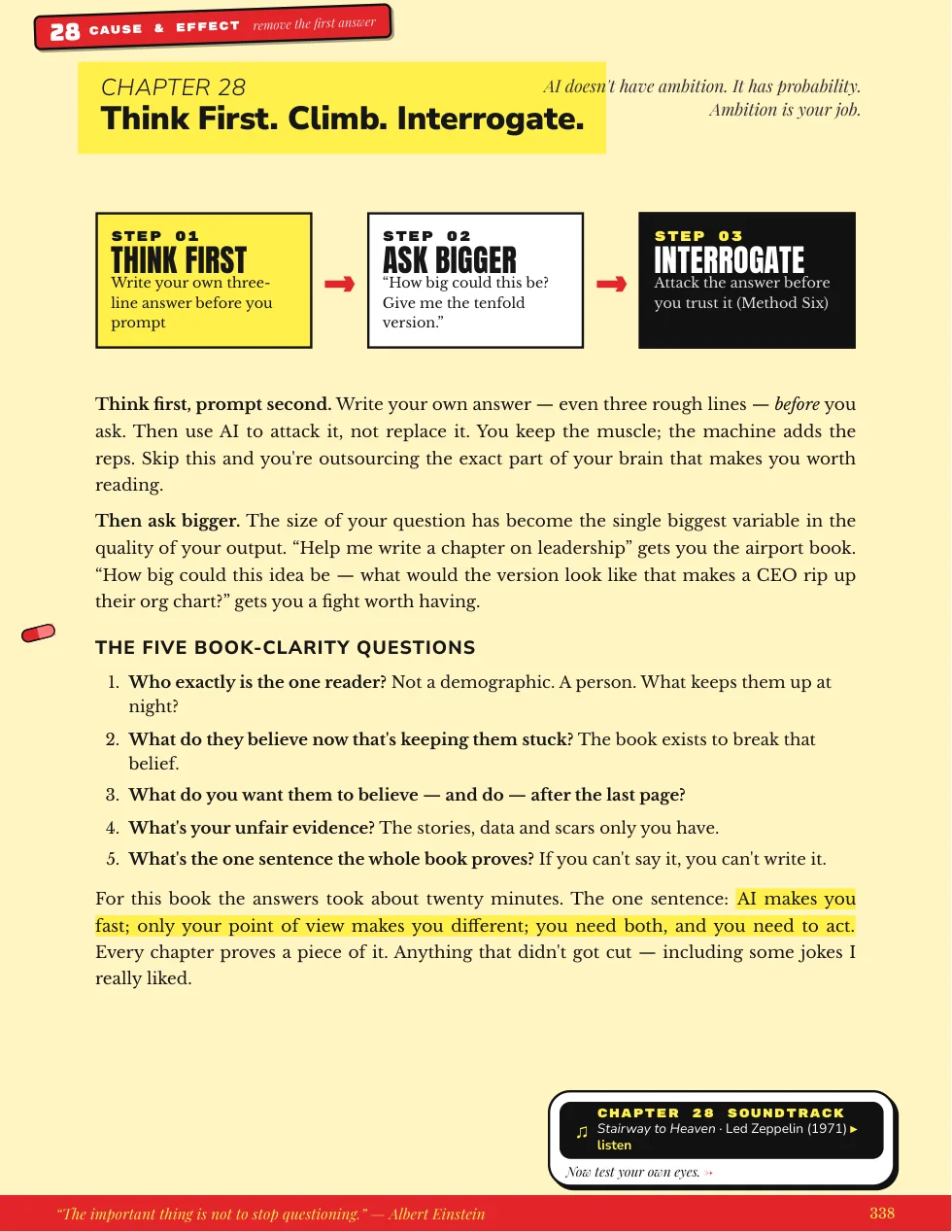
STEP 01 THINK FIRST Write your own three- line answer before you prompt → STEP 02 ASK BIGGER “How big could this be? Give me the tenfold version.” → STEP 03 INTERROGATE Attack the answer before you trust it (Method Six) Think first, prompt second. Write your own answer — even three rough lines — before you ask.

Then use AI to attack it, not replace it. You keep the muscle; the machine adds the reps. Skip this and you're outsourcing the exact part of your brain that makes you worth reading.

Then ask bigger. The size of your question has become the single biggest variable in the quality of your output. “Help me write a chapter on leadership” gets you the airport book.

“How big could this idea be — what would the version look like that makes a CEO rip up their org chart?” gets you a fight worth having. THE FIVE BOOK-CLARITY QUESTIONS 1. Who exactly is the one reader?

Not a demographic. A person. What keeps them up at night?

  1. What do they believe now that's keeping them stuck? The book exists to break that belief.

  2. What do you want them to believe — and do — after the last page? 4.

What's your unfair evidence? The stories, data and scars only you have. 5.

What's the one sentence the whole book proves? If you can't say it, you can't write it. For this book the answers took about twenty minutes.

The one sentence: AI makes you fast; only your point of view makes you different; you need both, and you need to act. Every chapter proves a piece of it. Anything that didn't got cut — including some jokes I really liked.

“The important thing is not to stop questioning.” — Albert Einstein 338

THE ORIGINAL · 340

THE OLDEST PROMPT ENGINEERING ON EARTH SIX HONEST SERVING-MEN. “I keep six honest serving-men / (They taught me all I knew); / Their names are What and Why and When / And How and Where and Who.” — Rudyard Kipling, 1902 WHY? Why this, why now, why you?

Ask it five times in a row. The fifth answer is the real one. WHO?

Who benefits if you stay exactly the same? Who said so first? Who's missing from the room?

WHERE? Where did you learn to want this? Where would nature solve it?

Where's the water you swim best in? WHEN? When did you last do something for the first time?

When does “later” actually arrive? (It doesn't.) HOW? How would you do it by Friday? How would your enemy do it?

How would a ten-year-old? WHAT? What would you do if nobody ever found out?

What's the most likely answer — and what's yours? AI answers questions. Only you decide which ones are worth asking.

Look for these six in the top corners of the pages ahead. Questions asked. Now climb the ladder. →

THE ORIGINAL · 341

CHAPTER 28 Climb the Ladder Same tool, worlds apart. The difference is where your thinking lives. 1x AWARE 10x DAILY USER 100x WORKFLOW BUILDER 1,000x CHAMPION 10,000x BUILDER leverage: none yet leverage: tasks leverage: processes leverage: other people leverage: systems YOU the rung where people get dumber ↘ I built this ladder to train an entire company on AI — front desk to corner office.

Each rung multiplies the one before it by ten, not because people type faster, but because the unit of leverage changes. At the bottom, AI helps you do a task. At the top, you build things that work for thousands of people while you sleep. (It's a leverage model, not a lab measurement.

Treat it like the Richter scale.) “Open the pod bay doors, HAL.” — 2001: A Space Odyssey (1968) 341 Juicero raised $100M+ to build a machine that lost a fight to a pair of human hands. HERD NOTE #08 Most people stall on rung two. Here's why. →

THE ORIGINAL · 342

the rung where people get dumber Most people — and most companies — stall at Daily User. It's comfortable. It feels like mastery: “I use AI for everything!” And it's exactly the rung where the dumbing-down happens, because Daily Users use AI to skip thinking.

Every rung above it requires more thinking, not less. You can't build a workflow without understanding the work. You can't champion what you can't explain.

You can't build a product without judgment about what's worth building. Daily User without thinking = average, faster · Builder with thinking = 10,000x RUNG SOUNDS LIKE THE TRAP CLIMB BY 1x Aware “I tried it once. It made something up.” Judging the whole technology by one bad prompt One real task a day for two weeks 10x Daily User “I use it for everything.” Outsourced thinking.

Workslop. Faster, blander, same. Think first.

Interrogate. Notice what you do three times a week. 100x Workflow Builder “I built a process that runs every time.” Automating a bad process — now it's a fast bad process Redesign the work before you automate it 1,000x Champion “My whole team uses what I built.” Becoming the help desk Teach people to fish.

Celebrate their builds. 10,000x Builder “We turned it into a product.” Building cool shit nobody needs Start from a big problem. Ship small.

Govern it like it matters. FOR AUTHORS, THE LADDER LOOKS LIKE THIS The Third-Time Rule: the third time you do the same task in a week, stop. Redesign it, then turn it into a workflow.

That one habit moves you from 10x toward 100x. Teach One: when something you built works, show one person how. That's the first step toward 1,000x.

10x: AI writes your chapters. (Congratulations, you made slop.) ✓ 100x: you build a repeatable book machine — Brain File, archive, skeleton, Interrogation. ✓ 1,000x: you teach your team or clients to run it in their own voice. ✓ 10,000x: the book becomes a keynote, a course, an app, an agent, a company. Every one points back to the others. ✓ AARON NOTE: my life up close is a mess. zoomed out it's a fractal. I'm selling the zoom.

Never trust a confident answer, including mine →

THE ORIGINAL · 343

CHAPTER 28 Interrogate Everything Never accept the first answer — from a machine, an expert, or me The most valuable skill of the AI era isn't prompting. It's interrogating. A smooth, confident, well-formatted answer feels true — psychologists call it processing fluency.

Confidence is a tone, not a test. And when the confident answer blows up later? Why are you surprised?

The signal was there. So you put the reasoning back by asking questions a machine can't answer with resemblance alone. WHAT'S THE MECHANISM?

Not the metaphor. Why, exactly, would this work? No cause, no answer.

1 WHO WOULD DISAGREE? Make it argue the strongest opposing view. If that side sounds smarter, you learned something.

2 WHAT WOULD MAKE THIS WRONG? Ask for the evidence that would kill the idea. Then go look for it.

3 STILL TRUE AFTER AI? Kill the pre-AI playbook before it kills you. 4 WOULD MY COMPETITOR GET THIS?

If yes, it's the average. Useful as a floor. Useless as a strategy.

5 WHAT'S THE 10X VERSION? Push past “better” to “different.” 6 WHAT DOESN'T IT KNOW ABOUT ME? Every gap in its picture of you gets filled with the average.

Find the gap. Fill it from your Brain File. 7 Minimum dose: run 1, 2 and 5 on anything you're about to act on — or publish with your name on it.

Never ship shit with your name on it. 0→YOU×AI YOU AARON NOTE: my life up close is a mess. zoomed out it's a fractal. I'm selling the zoom.

Questioned answers expose four bad analogies →

THE ORIGINAL · 344

four analogies AI loves that break businesses THE ANALOGY THE REALITY “Sales is a persuasion problem.” Usually a qualification problem. Persuade the wrong buyer and churn shows up six months later. “Scaling is turning up the volume.” Businesses have phase changes.

What works at 10 breaks at 100. “More content, more growth.” In a sea of machine-made sameness, distinct beats volume. “The customer journey is a funnel.” Buyers loop, skip and backtrack.

Optimizing a straight line that doesn't exist is expensive. THE ONE-LINE TEST Take one real question. Ask it cold.

Then ask it again after you've thought first, loaded your Brain File, asked the 10x question and run the Interrogation. Put the two answers side by side. The gap between them is the value of your point of view, made visible.

If the second isn't more specific, more causal and more yours, keep climbing. MY CHAPTER-LEVEL SLOP FILTERS Pro move: ask the AI to write the most predictable version of your chapter on purpose. Read it.

Then make sure yours shares nothing with it but the topic. Know the average so you can escape it. The stranger test: could anyone with internet access have written this paragraph?

Delete or rewrite. ✓ The scar test: is there at least one story per chapter that cost me something? ✓ The fight test: would at least one smart person disagree with this chapter? If not, it's too safe. Safe is just slow death with good manners. ✓ The bingo sweep: run the chapter against AI Slop Bingo.

Kill every square. ✓ The 1 a.m. test: does it sound like me talking to a friend, or like me presenting to a board? ✓ Real innovation has fewer sticky notes and more angry customers.

Soundtrack: Stairway to Heaven — Led Zeppelin (1971)

Exhibits

exhibit · debated

THINK FIRST. ASK BIGGER. INTERROGATE.

CHAPTER 28 Think First. Climb. Interrogate. AI doesn't have ambition. It has probability. Ambition is your job. STEP 01 THINK FIRST Write your own three- line answer before you prompt → STEP 02 ASK BIGGER “How big could this be? Give me the tenfold version.” → STEP 03 INTERROGATE Attack the answer before you trust it (Method Six) Think first, prompt second. Write your own answer — even three rough lines — before you ask. Then use AI to attack it, not replace it. You keep the muscle; the machine adds the reps. Skip this and you're outsourcing the exact part of your brain that makes you worth reading. Then ask bigger. The size of your question has become the single biggest variable in the quality of your output. “Help me write a chapter on leadership” gets you the airport book. “How big could this idea be — what would the version look like that makes a CEO rip up their org chart?” gets you a fight worth having. THE FIVE BOOK-CLARITY QUESTIONS 1. Who exactly is the one reader? Not a demographic. A person. What keeps them up at night? 2. What do they believe now that's keeping them stuck? The book exists to break that belief. 3. What do you want them to believe — and do — after the last page? 4. What's your unfair evidence? The stories, data and scars only you have. 5. What's the one sentence the whole book proves? If you can't say it, you can't write it. For this book the answers took about twenty minutes. The one sentence: AI makes you fast; only your point of view makes you different; you need both, and you need to act. Every chapter proves a piece of it. Anything that didn't got cut — including some jokes I really liked. “The important thing is not to stop questioning.” — Albert Einstein 338

Leave the default. Keep yourself.

Aaron Bare · Director’s Cut · author’s argument

mindfuck · verified

COUNT THE GRAY DOTS.

Hermann grid, 1870

exhibit

SIX SERVING-MEN

THE OLDEST PROMPT ENGINEERING ON EARTH SIX HONEST SERVING-MEN. “I keep six honest serving-men / (They taught me all I knew); / Their names are What and Why and When / And How and Where and Who.” — Rudyard Kipling, 1902 WHY? Why this, why now, why you? Ask it five times in a row. The fifth answer is the real one. WHO? Who benefits if you stay exactly the same? Who said so first? Who's missing from the room? WHERE? Where did you learn to want this? Where would nature solve it? Where's the water you swim best in? WHEN? When did you last do something for the first time? When does “later” actually arrive? (It doesn't.) HOW? How would you do it by Friday? How would your enemy do it? How would a ten-year-old? WHAT? What would you do if nobody ever found out? What's the most likely answer — and what's yours? AI answers questions. Only you decide which ones are worth asking. Look for these six in the top corners of the pages ahead. Questions asked. Now climb the ladder. →

exhibit

THE LADDER · 1x TO 10,000x

CHAPTER 28 Climb the Ladder Same tool, worlds apart. The difference is where your thinking lives. 1x AWARE 10x DAILY USER 100x WORKFLOW BUILDER 1,000x CHAMPION 10,000x BUILDER leverage: none yet leverage: tasks leverage: processes leverage: other people leverage: systems YOU the rung where people get dumber ↘ I built this ladder to train an entire company on AI — front desk to corner office. Each rung multiplies the one before it by ten, not because people type faster, but because the unit of leverage changes. At the bottom, AI helps you do a task. At the top, you build things that work for thousands of people while you sleep. (It's a leverage model, not a lab measurement. Treat it like the Richter scale.) “Open the pod bay doors, HAL.” — 2001: A Space Odyssey (1968) 341 Most people stall on rung two. Here's why. →

herd note

HERD NOTE #08

Juicero raised [amount omitted] to build a machine that lost a fight to a pair of human hands.

exhibit

THE RUNG WHERE PEOPLE GET DUMBER

the rung where people get dumber Most people — and most companies — stall at Daily User. It's comfortable. It feels like mastery: “I use AI for everything!” And it's exactly the rung where the dumbing-down happens, because Daily Users use AI to skip thinking. Every rung above it requires more thinking, not less. You can't build a workflow without understanding the work. You can't champion what you can't explain. You can't build a product without judgment about what's worth building. Daily User without thinking = average, faster · Builder with thinking = 10,000x RUNG SOUNDS LIKE THE TRAP CLIMB BY 1x Aware “I tried it once. It made something up.” Judging the whole technology by one bad prompt One real task a day for two weeks 10x Daily User “I use it for everything.” Outsourced thinking. Workslop. Faster, blander, same. Think first. Interrogate. Notice what you do three times a week. 100x Workflow Builder “I built a process that runs every time.” Automating a bad process — now it's a fast bad process Redesign the work before you automate it 1,000x Champion “My whole team uses what I built.” Becoming the help desk Teach people to fish. Celebrate their builds. 10,000x Builder “We turned it into a product.” Building cool shit nobody needs Start from a big problem. Ship small. Govern it like it matters. FOR AUTHORS, THE LADDER LOOKS LIKE THIS The Third-Time Rule: the third time you do the same task in a week, stop. Redesign it, then turn it into a workflow. That one habit moves you from 10x toward 100x. Teach One: when something you built works, show one person how. That's the first step toward 1,000x. 10x: AI writes your chapters. (Congratulations, you made slop.) ✓ 100x: you build a repeatable book machine — Brain File, archive, skeleton, Interrogation. ✓ 1,000x: you teach your team or clients to run it in their own voice. ✓ 10,000x: the book becomes a keynote, a course, an app, an agent, a company. Every one points back to the others. ✓ AARON NOTE: my life up close is a mess. zoomed out it's a fractal. I'm selling the zoom. Never trust a confident answer, including mine →

exhibit

INTERROGATE EVERYTHING

CHAPTER 28 Interrogate Everything Never accept the first answer — from a machine, an expert, or me The most valuable skill of the AI era isn't prompting. It's interrogating. A smooth, confident, well-formatted answer feels true — psychologists call it processing fluency. Confidence is a tone, not a test. And when the confident answer blows up later? Why are you surprised? The signal was there. So you put the reasoning back by asking questions a machine can't answer with resemblance alone. WHAT'S THE MECHANISM? Not the metaphor. Why, exactly, would this work? No cause, no answer. 1 WHO WOULD DISAGREE? Make it argue the strongest opposing view. If that side sounds smarter, you learned something. 2 WHAT WOULD MAKE THIS WRONG? Ask for the evidence that would kill the idea. Then go look for it. 3 STILL TRUE AFTER AI? Kill the pre-AI playbook before it kills you. 4 WOULD MY COMPETITOR GET THIS? If yes, it's the average. Useful as a floor. Useless as a strategy. 5 WHAT'S THE 10X VERSION? Push past “better” to “different.” 6 WHAT DOESN'T IT KNOW ABOUT ME? Every gap in its picture of you gets filled with the average. Find the gap. Fill it from your Brain File. 7 Minimum dose: run 1, 2 and 5 on anything you're about to act on — or publish with your name on it. Never ship shit with your name on it. 0→YOU×AI YOU AARON NOTE: my life up close is a mess. zoomed out it's a fractal. I'm selling the zoom. Questioned answers expose four bad analogies →

exhibit

FOUR ANALOGIES · THE SLOP FILTERS

four analogies AI loves that break businesses THE ANALOGY THE REALITY “Sales is a persuasion problem.” Usually a qualification problem. Persuade the wrong buyer and churn shows up six months later. “Scaling is turning up the volume.” Businesses have phase changes. What works at 10 breaks at 100. “More content, more growth.” In a sea of machine-made sameness, distinct beats volume. “The customer journey is a funnel.” Buyers loop, skip and backtrack. Optimizing a straight line that doesn't exist is expensive. THE ONE-LINE TEST Take one real question. Ask it cold. Then ask it again after you've thought first, loaded your Brain File, asked the 10x question and run the Interrogation. Put the two answers side by side. The gap between them is the value of your point of view, made visible. If the second isn't more specific, more causal and more yours, keep climbing. MY CHAPTER-LEVEL SLOP FILTERS Pro move: ask the AI to write the most predictable version of your chapter on purpose. Read it. Then make sure yours shares nothing with it but the topic. Know the average so you can escape it. The stranger test: could anyone with internet access have written this paragraph? Delete or rewrite. ✓ The scar test: is there at least one story per chapter that cost me something? ✓ The fight test: would at least one smart person disagree with this chapter? If not, it's too safe. Safe is just slow death with good manners. ✓ The bingo sweep: run the chapter against AI Slop Bingo. Kill every square. ✓ The 1 a.m. test: does it sound like me talking to a friend, or like me presenting to a board? ✓ RON NOTE: selling a clean life is a lie. selling the mess is marketing with a conscienc Analogies busted. Now test your own life. →

herd note

HERD NOTE #07

Real innovation has fewer sticky notes and more angry customers.

exhibit

RUN THE TESTS

“I know that I know nothing.” — Socrates, via Plato 345 FIVE TESTS FROM MAGNETIC ZERO · BRING A PEN RUN THE TESTS. KEEP WHAT PASSES. 1 THE TIMESTAMP TEST Find the story still filtering your life. Who said it? When? Would they still say it today? Nothing survives a timestamp. 2 THE TABLE TEST After an evening with someone: are you bigger or smaller? Plotting, or tired? 3 THE EXIT AUDIT What am I keeping open? What is it costing me? What one thing, if I chose it, would make the rest unnecessary? 4 THE DINNER-PARTY TEST Will today's catastrophe be a funny story in ten years? Ten years is the standard rate. Most things clear it in a week. 5 THE FOUR-WORD PEEL Swap “I am anxious” for “I'm having the thought that I'm anxious.” Four extra words and the label peels at the corner. my only gauge: am I having fun? c≠0 Interruption: Voltaire didn't say that either. →

interruption · barcandy

Judge a man by his questions rather than by his answers.

Even the quote about questions needed questioning.

"Voltaire" — actually Pierre-Marc-Gaston de Lévis, 1808

exhibit

SIX LAWS, QUIETLY

HYPERBOLIC DISCOUNTING $100 today beats $110 tomorrow, but $110 in 31 days beats $100 in 30. Your brain treats future-you like a stranger. THE SUNK COST TRAP “We’ve already spent so much.” Britain and France kept funding the Concorde long after the numbers failed. Past money is gone. Decide on the future. JEVONS’ PARADOX In 1865 William Stanley Jevons noticed more efficient steam engines made Britain burn more coal. Make something cheaper and we use far more of it. Now: ideas. BENFORD’S LAW In real-world numbers, about 30% start with a 1 and under 5% start with a 9. Fraud investigators use it, because faked numbers are “too random.” THE OVERTON WINDOW The range of ideas a society treats as acceptable (named for Joseph Overton). Today’s “crazy” is often tomorrow’s normal. Push the window. THE BUTTERFLY EFFECT Edward Lorenz, 1972: “Does the flap of a butterfly’s wings in Brazil set off a tornado in Texas?” Tiny changes, huge outcomes. You are the flap. VERIFIED VERIFIED NOTHING IS RANDOM. MOST THINGS ARE JUST UNEXAMINED. BEHAVIORAL ECONOMICS 347 THE LAWS OF WEIRD SIX LAWS THAT RUN THE WORLD QUIETLY. You’re obeying all of them right now. Better to know. v1.0 c≠0

interruption · verified

The unexamined life is not worth living.

The unexamined prompt isn't worth sending.

Socrates, in Plato's Apology

exhibit

THE LADDER FIELD MANUAL

1x AWARE “I tried it once. It made something up.” Climb by: Use it every day for a week on one real task. Judge the habit, not the first answer. 10x DAILY USER “I use AI for everything!” Climb by: Stop asking for answers. Ask it to question you. This is the rung where people get dumber, so climb out fast. 100x WORKFLOW BUILDER “This happens every week, so I built it once.” Climb by: Map one repeating process, give it your context and rules, and turn it into a reusable workflow. Think critically about what the work really is. 1,000x CHAMPION “Let me show you how.” Climb by: Teach it. Write the playbook, run the workshop, fix the incentives so your team wants to climb too. 10,000x BUILDER “Nobody has solved this yet.” Climb by: Combine tools, data and your own models into something that didn’t exist. Confront problems nobody has named. This is where the money and the impact are. A 10,000x EXAMPLE · a comedy research project I used AI to research 1,000 comedians across 2,500 years and break comedy into a science: 25 moves, a periodic table of funny, a comedy genome. AI did the research, the translation and the interpretation. The artist stays the artist. The jokes, the timing and the bombing are still mine. AI 349 THE LADDER · A FIELD MANUAL HOW TO GO FROM DAILY USER TO BUILDER. Every rung up takes more thinking, not less. Here’s the move for each one. 17 YOU

exhibit

PHILOSOPHER CARDS

SERIES 1 · COLLECT ALL SIX · DO NOT TRADE FOR NFTs PHILOSOPHER CARDS DIOGENES c. 412–323 BC Lived in a jar. Told Alexander the Great to get out of his sun. NERVE 99 BOOKS SOLD IN LIFETIME few SOCRATES c. 470–399 BC Asked so many questions they sentenced him to death. Never wrote a book. Respect. NERVE 95 BOOKS SOLD IN LIFETIME 0 NIETZSCHE 1844–1900 Chaos, dancing stars, a mustache that had its own weather system. NERVE 90 BOOKS SOLD IN LIFETIME few LAO TZU 6th c. BC (allegedly) Wrote 81 short chapters. Gets credited for quotes he never wrote. Relatable. NERVE 88 BOOKS SOLD IN LIFETIME few CAMUS 1913–1960 Pushed a rock uphill forever and called it happiness. Goalkeeper for Algiers. NERVE 92 BOOKS SOLD IN LIFETIME few OSCAR WILDE 1854–1900 The wittiest man in London. Still gets credit for things he didn't say. NERVE 97 BOOKS SOLD IN LIFETIME few none of them had a personal brand. all of them are still trending. Others' ideas aren't. →

The podcast · Launching 2027

Get the first episode in 2027. Better late than never.

By signing up you agree we can email you when the podcast launches. One email, maybe two. Unsubscribe anytime.

Visit the podcast →