ROOM 29
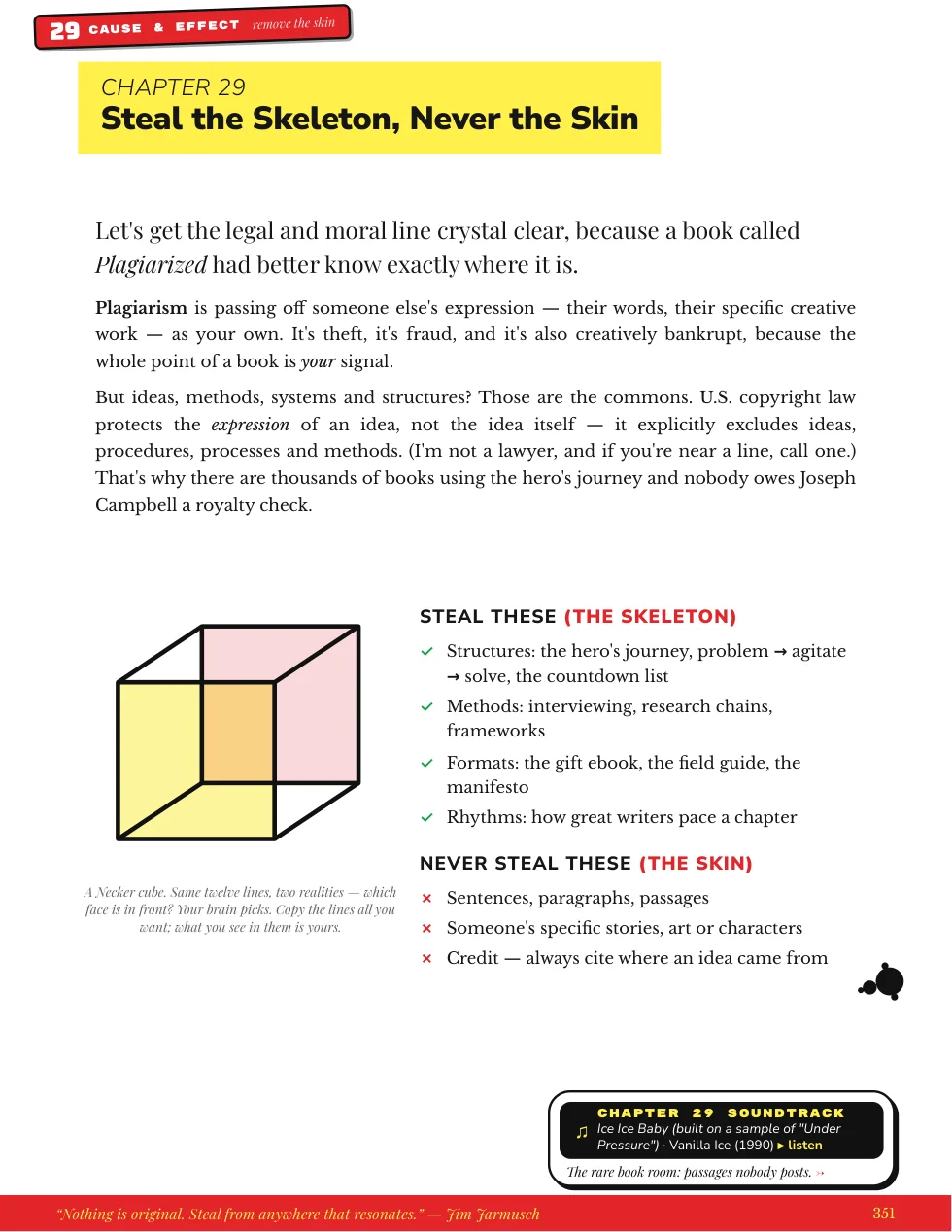
CHAPTER 29 Steal the Skeleton, Never the Skin Let's get the legal and moral line crystal clear, because a book called Plagiarized had better know exactly where it is. Plagiarism is passing off someone else's expression — their words, their specific creative work — as your own. It's theft, it's fraud, and it's also creatively bankrupt, because the whole point of a book is your signal.
But ideas, methods, systems and structures? Those are the commons. U.S. copyright law protects the expression of an idea, not the idea itself — it explicitly excludes ideas, procedures, processes and methods. (I'm not a lawyer, and if you're near a line, call one.) That's why there are thousands of books using the hero's journey and nobody owes Joseph Campbell a royalty check.
A Necker cube. Same twelve lines, two realities — which face is in front? Your brain picks.
Copy the lines all you want; what you see in them is yours. STEAL THESE (THE SKELETON) NEVER STEAL THESE (THE SKIN) Structures: the hero's journey, problem → agitate → solve, the countdown list ✓ Methods: interviewing, research chains, frameworks ✓ Formats: the gift ebook, the field guide, the manifesto ✓ Rhythms: how great writers pace a chapter ✓ Sentences, paragraphs, passages ✗ Someone's specific stories, art or characters ✗ Credit — always cite where an idea came from ✗ “Nothing is original. Steal from anywhere that resonates.” — Jim Jarmusch 351
THE ORIGINAL · 352
PLAGIARIZED · BY THREE INITIATES 352 THE RARE BOOK ROOM · VOL. II · PASSAGES NOBODY POSTS ON INSTAGRAM OBSCURE PAGES FROM DUSTY BOOKS. To think according to appearances is easy; to think truth regardless of appearances is laborious… it is the hardest work in the world. — Wallace D.
Wattles, The Science of Getting Rich, 1910 You are to become a creator, not a competitor. — Wallace D. Wattles, The Science of Getting Rich, 1910 Reading is thinking with some one else's head instead of one's own. — Arthur Schopenhauer, “On Thinking for Oneself,” 1851 · yes, put the book down sometimes Could the young but realize how soon they will become mere walking bundles of habits, they would give more heed to their conduct while in the plastic state. — William James, Principles of Psychology, ch. IV “Habit,” 1890 · neuroplasticity, 60 years early Men are anxious to improve their circumstances, but are unwilling to improve themselves; they therefore remain bound. — James Allen, As a Man Thinketh, 1903 Its force is above all force.
For it vanquishes every subtile thing & penetrates every solid thing. So was the world created. — The Emerald Tablet, in Isaac Newton's own translation · the physicist was an alchemist on weekends c≠0 v1.0 But leave a receipt. →
THE ORIGINAL · 353
steal with receipts Austin Kleon wrote a whole book on this in 2012 called Steal Like an Artist, and you'll notice I just credited him. That's the move. Steal with receipts.
Every idea I borrowed in this book is credited. Every study has a name and a year. That's not politeness.
That's what separates a remix from a rip-off. This very book is a demonstration — twice. I stole the skeleton of a copywriting guide, and I stole whole paragraphs from my own last book, Think Big.
Not Average. One of those is plagiarism. The other is the point.
For the first one, I took the structure of a copywriting guide I've owned for years — methods, then madness; big highlighted method titles; a narrator's voice running through it. Then I threw away everything else and filled the skeleton with my own ideas, my own frameworks, my own stories. Same bones.
Different animal. THE IMITATION GAME — THE AI VERSION 1. Pick three books you love in a genre you want to write in.
-
Ask AI to map their structure only: chapter function, pacing, where the stories go, how each chapter opens and closes. No content.
-
Build a hybrid skeleton from the three. Mutate it.
Add a section none of them have. 4. Fill it from your Brain File, your archive and your research — never from their pages.
- Run the Interrogation (Method Six) on every chapter. Imitation is how every artist learns.
Musicians learn covers before they write songs. Painters copy masters in museums. The crime isn't imitation.
The crime is stopping there. The test is simple: if the original author read your book, would they recognize their sentences? Then you stole the skin.
Would they recognize only their influence — and maybe feel a little proud? Then you stole the skeleton. Welcome to the tradition. v1.0
THE ORIGINAL · 355
“I'm gonna make him an offer he can't refuse.” — The Godfather (1972) 355 THE ENTIRE BOOK, IN ONE INSTRUCTION COPY THE BEST. IT'S FLATTERY. “Imitation is the sincerest of flattery.” — Charles Caleb Colton ✓ VERIFIED Lacon, 1820 “…that mediocrity can pay to greatness.” — “Oscar Wilde” ✗ BAR CANDY the internet's add-on. no solid source.
HOW THE GREATS STOLE Ben Franklin took essays from The Spectator, scrambled his notes, then rewrote them from memory and compared — his own Autobiography says so. Hunter S. Thompson retyped The Great Gatsby to feel the rhythm in his fingers. (Widely reported.
Hold it loosely.) Comedians learn by watching thousands of hours of tape. My FunnyAF rule: study everybody, copy nobody. Hold two thoughts: copy the craft.
Never the voice. EXERCISE · YOUR FIVE GREATS who what I'll steal (the craft) what I'll leave (the voice) 1. ____________ ____________________ ____________________ 2. ____________ ____________________ ____________________ 3. ____________ ____________________ ____________________ 4. ____________ ____________________ ____________________ 5. ____________ ____________________ ____________________ 0→YOU×AI
THE ORIGINAL · 356
GUESS MY RULE: 2 · 4 · 6 2 4 6 These three numbers follow a rule I have in mind. Write three more sequences you’d test to figure it out, then name the rule. ____ ____ ____ ____ ____ ____ ____ ____ ____ Answer: the rule is just “any three numbers going up.” In Peter Wason’s 1960 study most people tested only sequences that fit their guess (8-10-12…) and never tried one that could prove them wrong. That’s confirmation bias.
MAD LIBS: WRITE YOUR OWN SELF-HELP BESTSELLER The ____ (number) Habits of Highly ____ (adjective) People. Every morning at ____ (time), I ____ (verb) for ____ (number) minutes while drinking ____ (liquid). This changed my ____ (noun) forever.
If I can do it, so can ____ (celebrity). Buy my ____ (product). Congratulations.
You are now average at an expert level. Everything in this book is the opposite of this page. E K 4 7 GAME 3 · THE WASON CARD TEST Each card has a letter on one side and a number on the other.
Rule: if a card has a vowel on one side, it has an even number on the other. Which cards must you flip to test it? Fewer than 1 in 10 people get it right.
Answer: E and 7. Almost everyone picks E and 4. GAME BREAK 356 GAME BREAK · SEASON VI YOUR GUT IS CONFIDENT AND WRONG.
Three games about how easily we’re fooled, especially by ourselves.
THE ORIGINAL · 357
And “Good artists copy, great artists steal”? No source ties it to Picasso. Eliot’s line came first.
BAR CANDY “Immature poets imitate; mature poets steal.” — T. S. Eliot, The Sacred Wood (1920) 357 1120s Bernard of Chartres “dwarfs on the shoulders of giants” 1562 Arthur Brooke Romeus and Juliet, a poem 1597 Shakespeare Romeo and Juliet, plot borrowed 1675 Isaac Newton “shoulders of giants,” borrowed from Bernard 1870 Lautréamont “Plagiarism is necessary.
Progress implies it.” 1917 Duchamp Fountain: a store-bought urinal, signed 1920 T.S. Eliot “Immature poets imitate; mature poets steal.” 1967 Guy Debord lifts Lautréamont’s line, word for word 1969 The Winstons “Amen, Brother”: ~6 seconds of drums, sampled into whole genres NOW You this book, and whatever you make next THE FAMILY TREE OF STEALING EVEN THE QUOTES ABOUT PLAGIARISM WERE PLAGIARIZED. Nine hundred years of borrowing, in one line.
0→YOU×AI
THE ORIGINAL · 359
A PAID ADVERTISEMENT (NOBODY PAID FOR THIS) Tired of being average? Try new ORIGINAL ™ THE WORLD’S FIRST 100% ORIGINAL THOUGHT* ✔ Clinically unproven ✔ Zero calories, infinite attitude ✔ Makes you the most interesting person at brunch ✔ Pairs well with coffee and existential dread ✔ Not available in stores, or anywhere ✂ CLIP & SAVE Redeem for one free unoriginal idea. Valid everywhere.
Expires never. FREE *ORIGINAL™ contains traces of Plato, your mom, the internet, three podcasts you half-listened to and every book you ever read. Manufactured in a facility that also processes everyone else’s ideas.
Results may vary. Consult your curiosity before use. Side effects include laughing, questioning authority and accidentally becoming yourself.
NOW WITH MORE YOU! Now a thought from the shower. →
THE ORIGINAL · 362
PLAGIARIZED · BY THREE INITIATES 362 THE RARE BOOK ROOM · the machine C. HOPKINS · PUBLIC DOMAIN · NOBODY READS IT. STEAL IT.
SCIENTIFIC ADVERTISING. 1923. STILL UNDEFEATED.
- STILL UNDEFEATED. Ads are not written to entertain.
When they do, those entertainment seekers are little likely to be the people whom you want… They forget they are salesmen and try to be performers. Instead of sales, they seek applause. — Ch. 2, “Just Salesmanship” · 100 years before the viral video Figures which do not lie tell one at once the merits of an ad… All guesswork is eliminated.
Every mistake is conspicuous. One quickly loses his conceit by learning how often his judgment errs - often nine times in ten. — Ch. 4 · the original A/B test, in a three-piece suit Never be led in new paths by the blind.
Apply to your advertising ordinary common sense.