exhibit · debated
THE LINE TO TAKE WITH YOU
Think first, prompt second.
Leave the default. Keep yourself.
Aaron Bare · Director’s Cut · author’s argument
Wing I · Room 3
Unlearn FILTER — seeing only what your defaults let through. Upgrade: Pattern Recognition
You made about a hundred choices before lunch. You picked maybe four of them.
You came with factory settings. Everyone did.
A language. A religion or the lack of one. A favorite team you didn't pick. A way of saying "fine" when you aren't. An opinion about money that sounds suspiciously like your uncle's. None of it was installed with your consent. All of it runs in the background, like apps you forgot you downloaded.
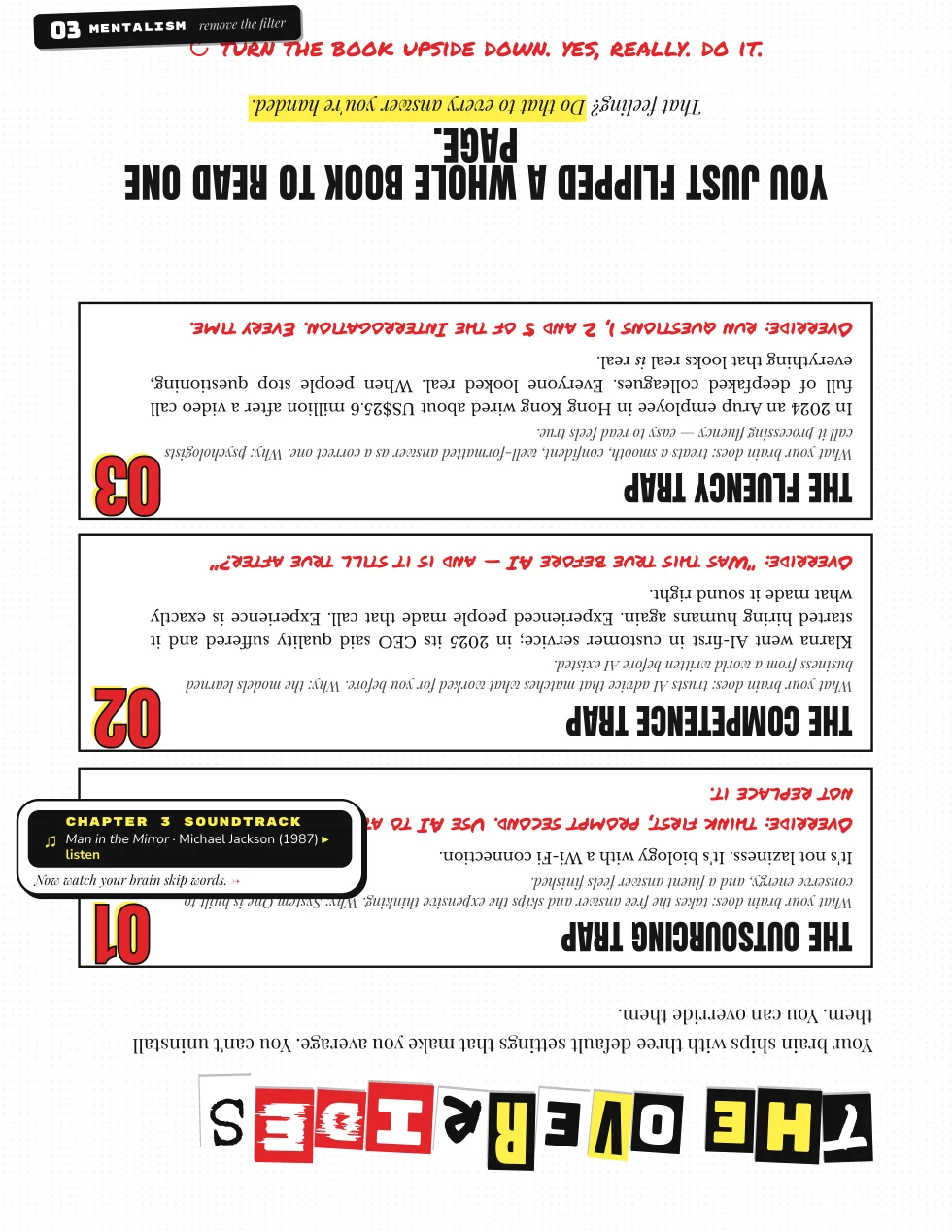
The machine has factory settings too. So does every company that buys one. Put them together and you get three traps.
THE DEFAULT ISN'T NEUTRAL. IT'S JUST SOMEONE ELSE'S CHOICE.
You hand over the thinking because it's there. Not because the machine is better, just because it's closer. The first draft becomes the final draft. The suggestion becomes the decision. You stop asking "is this right?" and start asking "is this done?"
✎ done ≠ right
This is the one companies fall into. The AI is good enough at the easy 80%, so everyone assumes it's good at the hard 20% too.
In 2025, Klarna, which had loudly replaced a big chunk of customer service with AI, said it would bring humans back because quality had slipped. The bot was competent. The customers wanted to be understood. Those aren't the same job. VERIFIED
Smooth sounds true. Confident sounds right. A familiar face sounds safe.
In 2024, an employee at the engineering firm Arup joined a video call with what looked and sounded like the CFO and colleagues. Every one of them was a deepfake. The employee sent about US$25.6 million before anyone noticed. VERIFIED
Fluency is now cheap. That means fluency is no longer evidence of anything.
IF IT SOUNDS RIGHT, CHECK IT TWICE.
You've seen the drawing: a small tip of conscious thought above the water, a massive block of automatic stuff underneath. People love to say "95% of your mind is subconscious." Nobody actually measured that number. It's a vibe with a decimal point. BAR CANDY
But the shape is real. Most of what you do, you don't decide in the moment. You run it. Habits, filters, reflexes, defaults. The tip of the iceberg thinks it's steering. Mostly it's narrating.
✎ the tip narrates. the ice drives.
This room's upgrade is Pattern Recognition. Not the machine's kind. Yours. The ability to notice "oh, that's a default" while it's happening, instead of three years later in therapy.
You don't need to rip out every setting. Some defaults are great. Brushing your teeth: keep. Saying thank you: keep. The point isn't to reject everything you were given. The point is to look at it once, on purpose, and decide.
Think first. Prompt second. When you do use the machine, make it show its work: what's proven, what's argued about, what's a myth people repeat at bars. That's the drill below. It labels every claim the way this installation does: verified, debated, bar candy.
Today's rep: change one default you never chose. The route you drive. The app you open first. The word you use when someone asks how you are. Tiny. Deliberate. Yours.
That's how you find the settings menu.
One insult outweighs a pile of compliments. One bad review haunts you longer than fifty good ones. That's not a character flaw — it's a factory setting. "Bad is stronger than good" is the literal title of a 2001 review paper by Baumeister and colleagues, and it has held up across studies. VERIFIED It kept your ancestors alive. It's keeping you small.
Good moments slide off unless you hold them. Rick Hanson's fix is almost stupidly small: when something good happens, stay with it for ten to twenty seconds. Let it land. You are teaching the Velcro to grab the right things.
And because this book fact-checks itself: a famous 2005 paper claimed flourishing begins at exactly 2.9013 positive emotions for every negative one. In 2013, Brown, Sokal and Friedman showed the math didn't work, and the claim was formally withdrawn. Even happiness science needs fact-checking. BAR CANDY What survives: more good than bad helps, and noticing the good is a trainable skill.
The ten classic cognitive distortions from CBT — David Burns, Feeling Good, 1980 — filed as software bugs. Mind reading: "they think I'm an idiot" — won't fix, you don't have that feature. Catastrophizing: "one bad email = career over" — patch by asking "then what?" three times. All-or-nothing: ship at 80%. Fortune telling: run the test. Labeling: "I'm bad with money" becomes "I made one bad money decision." Emotional reasoning: feelings are data, not verdicts.
You can't uninstall the bugs. You can recognize them faster. Every time you catch one and label it, the next one is easier to catch. That's cognitive behavioral therapy in one sentence, and some of the best-tested psychology there is. VERIFIED
✎ release notes: you are the developer on call. forever.
You can live weeks without food, days without water, and about three minutes without breathing. So why is it the one thing nobody trains? The rep from this chapter's first Tree Break: four rounds of box breathing — in four, hold four, out four, hold four — before you open your phone. Your nervous system gets the first download of the day, not your inbox.
HOW PEOPLE ACTUALLY WORK THE ICEBERG. ABOVE THE WATERLINE: what they say, what they do, what they post, the job title, the opinion at dinner. The part you argue with.
HABITS EMOTIONS BELIEFS VALUES FEARS IDENTITY CONDITIONING who raised them · what scared them · what paid them You can't change anyone's mind by arguing with the tip. The tip is just the part that sticks out. Every fight you've had with a “wrong” person was a collision with the 90% you couldn't see.
Including yours. AI only ever sees your tip — your prompt. Your Brain File is how you send it some of the ice.
Bar candy check: the famous “95% of your mind is subconscious” number has no solid measurement behind it. I've said it on stage. The exact number is fake.
The shape is real. 17 v1.0 History skipped average people. →
VELCRO One insult outweighs a pile of compliments. One bad review haunts you longer than fifty good ones. “Bad is stronger than good” is the title of a 2001 review paper by Baumeister and colleagues, and it holds up across studies.
TEFLON Good moments slide off unless you hold them. Rick Hanson’s fix: when something good happens, stay with it for 10 to 20 seconds. Let it land.
You are teaching the Velcro to grab the right things. VERIFIED THE HAPPINESS RATIO THAT WAS A LIE A famous 2005 paper said flourishing begins at exactly 2.9013 positive emotions for every negative one. In 2013, Brown, Sokal and Friedman showed the math didn’t work, and the claim was formally withdrawn.
Even happiness science needs fact-checking. What survives: more good than bad helps, and noticing the good is a skill you can train. BAR CANDY FOCUS IS A VOTE.
VOTE FOR THE GOOD STUFF ON PURPOSE. 59 WHY GOOD NEWS SLIDES OFF YOUR BRAIN IS VELCRO FOR BAD, TEFLON FOR GOOD. It kept your ancestors alive.
It’s keeping you small.
TICKET BUG SYMPTOM FIX BUG-001 Mind reading “They think I’m an idiot.” Won’t fix. You don’t have that feature. BUG-002 Catastrophizing “One bad email = career over.” Patch: ask “then what?” three times.
BUG-003 All-or-nothing “If it’s not perfect, it’s garbage.” Patch: ship at 80%. BUG-004 Fortune telling “It’ll never work.” Patch: run the test. BUG-005 Personalization “The meeting went badly because of me.” Patch: Deming’s 94%.
BUG-006 “Should” statements “I should be further along by now.” Patch: compared to whom? BUG-007 Labeling “I’m bad with money.” Patch: “I made one bad money decision.” BUG-008 Emotional reasoning “I feel stupid, so I am.” Patch: feelings are data, not verdicts. RELEASE NOTES You can’t uninstall the bugs.
You can recognize them faster. Every time you catch one and label it, the next one is easier to catch. That’s cognitive behavioral therapy in one sentence, and some of the best-tested psychology there is.
“Do. Or do not. There is no try.” — The Empire Strikes Back (1980) 61 YOUR BRAIN’S ISSUE TRACKER · 8 OPEN TICKETS BUG REPORT: THINKING.EXE The ten classic “cognitive distortions” from CBT (David Burns, Feeling Good, 1980), filed as software bugs.
Here are the eight worst offenders. v1.0
Soundtrack: Man in the Mirror — Michael Jackson (1987)
Think first, prompt second.
Leave the default. Keep yourself.
Aaron Bare · Director’s Cut · author’s argument
HOW PEOPLE ACTUALLY WORK THE ICEBERG. ABOVE THE WATERLINE: what they say, what they do, what they post, the job title, the opinion at dinner. The part you argue with. HABITS EMOTIONS BELIEFS VALUES FEARS IDENTITY CONDITIONING who raised them · what scared them · what paid them You can't change anyone's mind by arguing with the tip. The tip is just the part that sticks out. Every fight you've had with a “wrong” person was a collision with the 90% you couldn't see. Including yours. AI only ever sees your tip — your prompt. Your Brain File is how you send it some of the ice. Bar candy check: the famous “95% of your mind is subconscious” number has no solid measurement behind it. I've said it on stage. The exact number is fake. The shape is real. 17 v1.0 History skipped average people. →
Two thousand years before the comment section, a former slave explained the comment section.
Epictetus, Enchiridion ch. 5
OPEN THE BOX. a guarantee on the outside means nothing about the inside. Look at four gray bars. Your eyes will lie. →
White's illusion, 1979
VELCRO One insult outweighs a pile of compliments. One bad review haunts you longer than fifty good ones. “Bad is stronger than good” is the title of a 2001 review paper by Baumeister and colleagues, and it holds up across studies. TEFLON Good moments slide off unless you hold them. Rick Hanson’s fix: when something good happens, stay with it for 10 to 20 seconds. Let it land. You are teaching the Velcro to grab the right things. VERIFIED THE HAPPINESS RATIO THAT WAS A LIE A famous 2005 paper said flourishing begins at exactly 2.9013 positive emotions for every negative one. In 2013, Brown, Sokal and Friedman showed the math didn’t work, and the claim was formally withdrawn. Even happiness science needs fact-checking. What survives: more good than bad helps, and noticing the good is a skill you can train. BAR CANDY FOCUS IS A VOTE. VOTE FOR THE GOOD STUFF ON PURPOSE. 59 WHY GOOD NEWS SLIDES OFF YOUR BRAIN IS VELCRO FOR BAD, TEFLON FOR GOOD. It kept your ancestors alive. It’s keeping you small.
A Roman emperor journaling at night. The original Brain File.
Marcus Aurelius, Meditations (common translation)
TICKET BUG SYMPTOM FIX BUG-001 Mind reading “They think I’m an idiot.” Won’t fix. You don’t have that feature. BUG-002 Catastrophizing “One bad email = career over.” Patch: ask “then what?” three times. BUG-003 All-or-nothing “If it’s not perfect, it’s garbage.” Patch: ship at 80%. BUG-004 Fortune telling “It’ll never work.” Patch: run the test. BUG-005 Personalization “The meeting went badly because of me.” Patch: Deming’s 94%. BUG-006 “Should” statements “I should be further along by now.” Patch: compared to whom? BUG-007 Labeling “I’m bad with money.” Patch: “I made one bad money decision.” BUG-008 Emotional reasoning “I feel stupid, so I am.” Patch: feelings are data, not verdicts. RELEASE NOTES You can’t uninstall the bugs. You can recognize them faster. Every time you catch one and label it, the next one is easier to catch. That’s cognitive behavioral therapy in one sentence, and some of the best-tested psychology there is. “Do. Or do not. There is no try.” — The Empire Strikes Back (1980) 61 YOUR BRAIN’S ISSUE TRACKER · 8 OPEN TICKETS BUG REPORT: THINKING.EXE The ten classic “cognitive distortions” from CBT (David Burns, Feeling Good, 1980), filed as software bugs. Here are the eight worst offenders. v1.0
Defaults don't just sit there. They loop. Next room: the render loop.
The podcast · Launching 2027
By signing up you agree we can email you when the podcast launches. One email, maybe two. Unsubscribe anytime.
Visit the podcast →