exhibit · debated
THE LINE TO TAKE WITH YOU
How a thought becomes a result — and how the result becomes your next thought
Leave the default. Keep yourself.
Aaron Bare · Director’s Cut · author’s argument
Wing I · Room 4
Unlearn OLD EVIDENCE — replaying yesterday's thoughts and calling it reality. Upgrade: Pattern Recognition
You're thinking a thought right now that you also thought yesterday. And the day before.
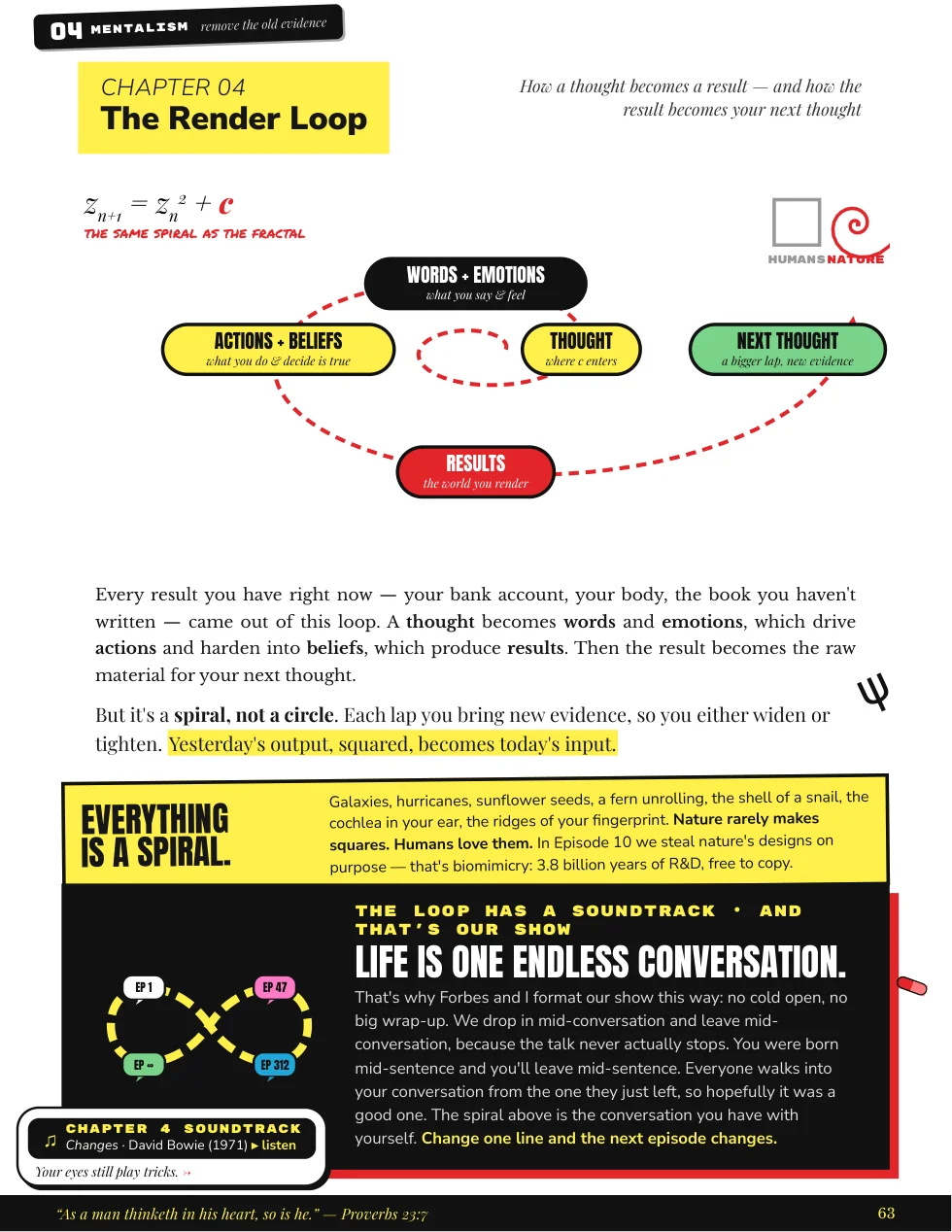
Here's the loop. Watch it run.
A thought shows up. I'm bad at this.
It turns into words and emotions. You say "I'm just not a numbers person." Your chest tightens a little.
Those become actions and beliefs. You avoid the spreadsheet. You let someone else do it. You start to believe it's simply true.
Which creates results. You don't get better at numbers, because you never touch numbers.
And the result feeds the next thought. See? I'm bad at this.
IT'S NOT A CIRCLE. IT'S A SPIRAL.
Every lap goes a little deeper. That's the bad news. It's also the whole trick, because spirals go up too.
✎ thought → words → actions → results → thought
Mathematicians write a version of this: z<sub>n+1</sub> = z<sub>n</sub>² + c. Take where you are, square it, add a constant, repeat. Run it enough times and you get the Mandelbrot set: endless, wild, never the same twice. Change the c, and you change the whole universe it draws.
Your render loop works the same way. Yesterday's output becomes today's input. And c, the one thing you add each time, is you.
Your brain is efficient. When the same path fires again and again, it gets easier to fire. Donald Hebb described this in 1949, and Carla Shatz later shrank it into a line you can put on a mug: neurons that fire together wire together. VERIFIED
That's how you learn piano. It's also how you learn to panic at email.
Then the inputs get framed for you. In 1981, Amos Tversky and Daniel Kahneman showed that the same medical choice, described as "200 people saved" or "400 people die," flips which option people pick. Same facts. Different frame. Different decision. VERIFIED
And defaults steer harder than arguments. Eric Johnson and Daniel Goldstein found organ-donation consent rates were dramatically higher in countries where you're a donor unless you opt out. People didn't love organs more. The box was just pre-ticked. VERIFIED
In 1974, Elizabeth Loftus and John Palmer showed people a car crash film, then asked how fast the cars were going when they "smashed" or "hit" each other. The "smashed" group guessed higher speeds, and a week later more of them remembered broken glass that wasn't there. VERIFIED
In 2000, Karim Nader and colleagues showed that when a memory is recalled, it becomes editable before it's stored again. Every time you replay it, you're re-saving it. VERIFIED
You may have heard "87% of your memories are false." Nobody measured that. It's a number wearing a lab coat. BAR CANDY The real finding is weirder and more useful: memories aren't fake, they're live files.
YOU'RE NOT REPLAYING THE PAST. YOU'RE RE-RENDERING IT.
Which means "but this always happens to me" is not proof. It's an old render, re-saved a thousand times, run through the same frame, defended by the same default. It feels like evidence because you've seen it so often. That's exactly why it isn't.
Now add the machine. If you feed an AI your old loop, it will help you run it faster. Better-written excuses. More polished self-doubt.
FAST AVERAGE IS STILL AVERAGE. IT'S JUST AVERAGE WITH A JET ENGINE.
You don't break a spiral at the results. Results are lagging. You break it at the thought, or the word. Swap "I'm not a numbers person" for "I haven't practiced numbers yet." It sounds tiny. It changes the next action. The next action changes the result. The result changes the next thought.
Today, catch one thought that keeps coming back and write down the result it keeps producing. Then give the machine your Brain File, the prompt below, so when it helps, it helps you instead of the average version of you.
ANCIENT THOUGHT, MODERN NEUROSCIENCE · YOUR BRAIN IS PLASTIC (THE GOOD KIND) NEURONS THAT FIRE TOGETHER WIRE TOGETHER. neuroscientist Carla Shatz's 1992 summary of Donald Hebb's 1949 theory. the Buddha said it shorter: “what we think, we become.” (paraphrase. bar candy-adjacent.) NEURON A “the old story” NEURON B “the new story” ↑ the synapse: a gap you can't see ellow = neurotransmitters crossing · black = receptors catchin THE OLD HABIT · walked 10,000 times · myelinated THE NEW HABIT · walked 3 times · keep walking ~86 BILLION neurons, each with up to thousands of synapses. You are a city of conversations. PLASTICITY Every repetition strengthens a path.
Every skip weakens one. Your brain is literally voting on who you'll be. MYELIN Paths you use get insulated and fire faster.
That's why old habits feel like “just who I am.” They're just paved.
“What if there is no tomorrow? There wasn't one today.” — Groundhog Day (1993) 67 BEHAVIORAL ECONOMICS · HOW YOU GET STEERED WITHOUT NOTICING YOU DON'T MAKE CHOICES. YOU PICK WHAT SOMEONE ARRANGED. 🖼️ FRAMING · SAME 600 PEOPLE TVERSKY & KAHNEMAN, SCIENCE, 1981 A disease will kill 600 people.
Pick a treatment plan. Doctors and students got the identical option, worded two ways: “200 PEOPLE WILL BE SAVED.” 72% chose this plan = “400 PEOPLE WILL DIE.” 22% chose this plan Facts don't speak. Frames do.
Flip it: before you retell your story, rewrite the frame. NUDGING 12% 99.98% GERMANY · OPT-IN AUSTRIA · OPT-OU The default decides. Organ-donor sign-up when you must opt in vs. when you must opt out (Johnson & Goldstein, 2003).
FILTERING Buy a red car and suddenly red cars are everywhere. They always were. Your filter changed.
CHOICE ARCHITECTURE ← EYE LEVEL WINS There is no neutral shelf. Fruit at eye level gets eaten. Thaler & Sunstein, Nudge (2008).
CONDITIONING = Pavlov rang a bell. Your phone buzzes. Same drool, different bell.
ANCHORING $20 $150 $1,000 The first number drags every number after it. The $1,000 option sells the $150 one.
THE BIG IDEA · AWARENESS IS THE RECONDITIONING YOU CAN'T CHANGE WHAT YOU CAN'T SEE. SO SEE IT. CONSCIOUS · ~5% What you think you're running.
The narrator. The PR department. SUBCONSCIOUS Habits, reflexes, the drive home you don't remember.
Fast, efficient, trained by repetition. UNCONSCIOUS The protector. Old fears, family downloads, the 7-year-old still guarding the door.
THE STORY Memories aren't files. Each time you recall one, it gets rewritten slightly before it's stored again. Neuroscientists call it reconsolidation (Nader, 2000).
1 NOTICE Catch the reflex mid- flight. “There it is again.” 2 NAME “That's my dad's voice, 1984.” Timestamp it. 3 QUESTION Is it true?
Is it mine? Does it still serve? 4 REWRITE Recall it with what you know now.
Same facts. New frame. Store the new version.
Real trauma deserves a real therapist. This page is for the stories, not a substitute for help. Rewriting the story is a practice, not a party trick. baaa.
THE MOST VALUABLE THING YOU OWN ATTENTION. You trade time for it. Companies trade money for it.
Your body burns energy paying it. Every feed, ad and notification on earth is bidding for the same thing: the next few seconds of you. “A wealth of information creates a poverty of attention,” wrote the economist Herbert Simon in 1971.
He was early. THIS BOOK MESSES WITH YOUR EYES ON PURPOSE. NOW YOU KNOW THE TRICK.
USE IT. DON’T LET IT USE YOU. TIME The only one you can’t earn back.
MONEY Spent buying attention, then spent because of it. ENERGY Every switch of focus costs you some. FIRST TIME?
WHAT A ATTENTION PAGE IS p. 20 → The story you are rewriting is rewriting itself already → ATTENTION 1/4 next → p.181
YOUR MEMORY ISN'T A RECORDING. IT'S A REMIX. YOU DON'T REMEMBER YOUR LIFE.
YOU REWRITE IT. ONE WORD CHANGES THE CRASH · LOFTUS & PALMER, 1974 People watched the same film of a car accident. Then they were asked how fast the cars were going when they hit — or when they smashed into each other.
34.0 mph “HIT” 40.8 mph “SMASHED” A week later, the “smashed” group was more than twice as likely to remember broken glass. There was no broken glass. ~25% THE LOST-IN-THE-MALL STUDY Loftus, 1995: about a quarter of people came to “remember” a childhood day being lost in a mall that never happened. SURE.
CONFIDENT. WRONG. After 9/11, people's memories of where they were drifted over time — but their confidence stayed sky- high (Talarico & Rubin, 2003).
EVERY RECALL IS A REWRITE Each time you remember something, you rebuild it and save the new version. Reconsolidation. The story you tell most is the one you've edited most. ✗ BAR CANDY You've heard “87% of your memories are false.” There's no study behind that number.
The real science is stranger: all memories are reconstructed. Some just drift further. So if you're rewriting it anyway… rewrite it toward who you're becoming. c≠0
here's the point… Most people run the loop with c = 0. They think the thoughts the feed gave them, say the words their industry says, feel the emotions the news ordered for them, take the actions everyone takes, believe what the herd believes — and get the results everybody gets. A circle.
Smooth. Predictable. Done.
The loop isn't the enemy. The loop is just physics. The question is whether you inject something new on every pass.
Your c. Your point of view. And here's where AI changes the math: it lets you run the loop a hundred times faster.
Which is fantastic if you're adding c — and a catastrophe if you're not. Fast average is still average. It's just average with a jet engine.
STAGE THE MATRIX DEFAULT THE CHEEKY HACK THE AI MOVE Thought Borrowed from the feed Question the premise first Have AI interview you before it writes a word Words + Emotions Jargon, safe, beige Say the thing you'd say at 1 a.m. to a friend Feed it your real voice: transcripts, voice memos, rants Actions + Beliefs Wait for permission Ship small, ship ugly, ship now Delegate drafts; keep judgment Results Same as everyone Weird enough to remember Measure, patch, loop again And a book is just the render loop, scaled. Your thought becomes your words, your words become the reader's emotions, their emotions become their actions, their actions become their results. Publish slop and you're literally installing average in other people's heads.
Publish your c and you hand them a way out. “The happiness of your life depends upon the quality of your thoughts.” — Marcus Aurelius, Meditations (common transla… 72 WHAT IS c? SAME FORMULA.
THREE DIFFERENT c's. z → z² + c c = 0 a plain circle. the herd. c = −0.8 + 0.156i a dragon. c = 0.285 + 0.01i a galaxy. Every point runs the identical loop: square it, add c, repeat. The only thing that changes is c.
Nudge it a hair and you get a different universe. In your life, c is your point of view: your stories, your scars, your taste, the weird 52 years only you lived. AI hands everyone the same z².
Nobody can hand you your c. CHANGE THE C. CHANGE THE UNIVERSE.
Section one is over. You know why. Now here's how. baaa. baaa.
ON NOTE: the author of this page has been wrong in print. see the roast. see the receip Interruption: the daily paper of fake wisdom. →
Soundtrack: Changes — David Bowie (1971)
How a thought becomes a result — and how the result becomes your next thought
Leave the default. Keep yourself.
Aaron Bare · Director’s Cut · author’s argument
afterimage
ANCIENT THOUGHT, MODERN NEUROSCIENCE · YOUR BRAIN IS PLASTIC (THE GOOD KIND) NEURONS THAT FIRE TOGETHER WIRE TOGETHER. neuroscientist Carla Shatz's 1992 summary of Donald Hebb's 1949 theory. the Buddha said it shorter: “what we think, we become.” (paraphrase. bar candy-adjacent.) NEURON A “the old story” NEURON B “the new story” ↑ the synapse: a gap you can't see ellow = neurotransmitters crossing · black = receptors catchin THE OLD HABIT · walked 10,000 times · myelinated THE NEW HABIT · walked 3 times · keep walking ~86 BILLION neurons, each with up to thousands of synapses. You are a city of conversations. PLASTICITY Every repetition strengthens a path. Every skip weakens one. Your brain is literally voting on who you'll be. MYELIN Paths you use get insulated and fire faster. That's why old habits feel like “just who I am.” They're just paved.
I opened my own course with this, credited to Lao Tzu. He never wrote it. Bar candy, served by the author. Still true.
"Lao Tzu" — nowhere in the Tao Te Ching
Certainty is just a prediction that hasn't been checked yet.
“What if there is no tomorrow? There wasn't one today.” — Groundhog Day (1993) 67 BEHAVIORAL ECONOMICS · HOW YOU GET STEERED WITHOUT NOTICING YOU DON'T MAKE CHOICES. YOU PICK WHAT SOMEONE ARRANGED. 🖼️ FRAMING · SAME 600 PEOPLE TVERSKY & KAHNEMAN, SCIENCE, 1981 A disease will kill 600 people. Pick a treatment plan. Doctors and students got the identical option, worded two ways: “200 PEOPLE WILL BE SAVED.” 72% chose this plan = “400 PEOPLE WILL DIE.” 22% chose this plan Facts don't speak. Frames do. Flip it: before you retell your story, rewrite the frame. NUDGING 12% 99.98% GERMANY · OPT-IN AUSTRIA · OPT-OU The default decides. Organ-donor sign-up when you must opt in vs. when you must opt out (Johnson & Goldstein, 2003). FILTERING Buy a red car and suddenly red cars are everywhere. They always were. Your filter changed. CHOICE ARCHITECTURE ← EYE LEVEL WINS There is no neutral shelf. Fruit at eye level gets eaten. Thaler & Sunstein, Nudge (2008). CONDITIONING = Pavlov rang a bell. Your phone buzzes. Same drool, different bell. ANCHORING $20 $150 $1,000 The first number drags every number after it. The $1,000 option sells the $150 one.
impossible trident, c. 1964
THE BIG IDEA · AWARENESS IS THE RECONDITIONING YOU CAN'T CHANGE WHAT YOU CAN'T SEE. SO SEE IT. CONSCIOUS · ~5% What you think you're running. The narrator. The PR department. SUBCONSCIOUS Habits, reflexes, the drive home you don't remember. Fast, efficient, trained by repetition. UNCONSCIOUS The protector. Old fears, family downloads, the 7-year-old still guarding the door. THE STORY Memories aren't files. Each time you recall one, it gets rewritten slightly before it's stored again. Neuroscientists call it reconsolidation (Nader, 2000). 1 NOTICE Catch the reflex mid- flight. “There it is again.” 2 NAME “That's my dad's voice, 1984.” Timestamp it. 3 QUESTION Is it true? Is it mine? Does it still serve? 4 REWRITE Recall it with what you know now. Same facts. New frame. Store the new version. Real trauma deserves a real therapist. This page is for the stories, not a substitute for help. Rewriting the story is a practice, not a party trick. baaa.
This site messes with your eyes on purpose. Now you know the trick.
YOUR MEMORY ISN'T A RECORDING. IT'S A REMIX. YOU DON'T REMEMBER YOUR LIFE. YOU REWRITE IT. ONE WORD CHANGES THE CRASH · LOFTUS & PALMER, 1974 People watched the same film of a car accident. Then they were asked how fast the cars were going when they hit — or when they smashed into each other. 34.0 mph “HIT” 40.8 mph “SMASHED” A week later, the “smashed” group was more than twice as likely to remember broken glass. There was no broken glass. ~25% THE LOST-IN-THE-MALL STUDY Loftus, 1995: about a quarter of people came to “remember” a childhood day being lost in a mall that never happened. SURE. CONFIDENT. WRONG. After 9/11, people's memories of where they were drifted over time — but their confidence stayed sky- high (Talarico & Rubin, 2003). EVERY RECALL IS A REWRITE Each time you remember something, you rebuild it and save the new version. Reconsolidation. The story you tell most is the one you've edited most. ✗ BAR CANDY You've heard “87% of your memories are false.” There's no study behind that number. The real science is stranger: all memories are reconstructed. Some just drift further. So if you're rewriting it anyway… rewrite it toward who you're becoming. c≠0
here's the point… Most people run the loop with c = 0. They think the thoughts the feed gave them, say the words their industry says, feel the emotions the news ordered for them, take the actions everyone takes, believe what the herd believes — and get the results everybody gets. A circle. Smooth. Predictable. Done. The loop isn't the enemy. The loop is just physics. The question is whether you inject something new on every pass. Your c. Your point of view. And here's where AI changes the math: it lets you run the loop a hundred times faster. Which is fantastic if you're adding c — and a catastrophe if you're not. Fast average is still average. It's just average with a jet engine. STAGE THE MATRIX DEFAULT THE CHEEKY HACK THE AI MOVE Thought Borrowed from the feed Question the premise first Have AI interview you before it writes a word Words + Emotions Jargon, safe, beige Say the thing you'd say at 1 a.m. to a friend Feed it your real voice: transcripts, voice memos, rants Actions + Beliefs Wait for permission Ship small, ship ugly, ship now Delegate drafts; keep judgment Results Same as everyone Weird enough to remember Measure, patch, loop again And a book is just the render loop, scaled. Your thought becomes your words, your words become the reader's emotions, their emotions become their actions, their actions become their results. Publish slop and you're literally installing average in other people's heads. Publish your c and you hand them a way out. “The happiness of your life depends upon the quality of your thoughts.” — Marcus Aurelius, Meditations (common transla… 72 WHAT IS c? SAME FORMULA. THREE DIFFERENT c's. z → z² + c c = 0 a plain circle. the herd. c = −0.8 + 0.156i a dragon. c = 0.285 + 0.01i a galaxy. Every point runs the identical loop: square it, add c, repeat. The only thing that changes is c. Nudge it a hair and you get a different universe. In your life, c is your point of view: your stories, your scars, your taste, the weird 52 years only you lived. AI hands everyone the same z². Nobody can hand you your c. CHANGE THE C. CHANGE THE UNIVERSE. Section one is over. You know why. Now here's how. baaa. baaa. ON NOTE: the author of this page has been wrong in print. see the roast. see the receip Interruption: the daily paper of fake wisdom. →
Stroop, 1935
THE FORER EFFECT · 1949 Psychologist Bertram Forer gave his students a “personal” personality profile. They rated its accuracy at about 4.3 out of 5. Then he told them: everyone got the same text, mostly pulled from a newsstand astrology book. The same trick powers horoscopes, cold readers and plenty of personality quizzes. Today it’s often called the Barnum effect. WHY IT WORKS Vague + flattering + two-sided (“outgoing, but sometimes reserved”) means everyone fits. Your brain does the rest: it hunts for the matches, skips the misses, and calls the result “so me.” VERIFIED THE MENTALISM LESSON If one paragraph can convince you it was written for you, imagine what you’ve accepted about yourself from a parent, a boss, a feed or a bad year. Most of the “you” you believe in was handed to you. You get to audit it, and you get to rewrite it. MINDFUCK REVEALED 76 MINDFUCK REVEALED EVERYONE GOT THE SAME READING. Every single copy of this book. Same paragraph. Word for word. c≠0 ψ 0→YOU×AI
Akiyoshi Kitaoka, 2003
The loop runs on whatever you feed it. Next room: who's holding the spoon.
The podcast · Launching 2027
By signing up you agree we can email you when the podcast launches. One email, maybe two. Unsubscribe anytime.
Visit the podcast →